
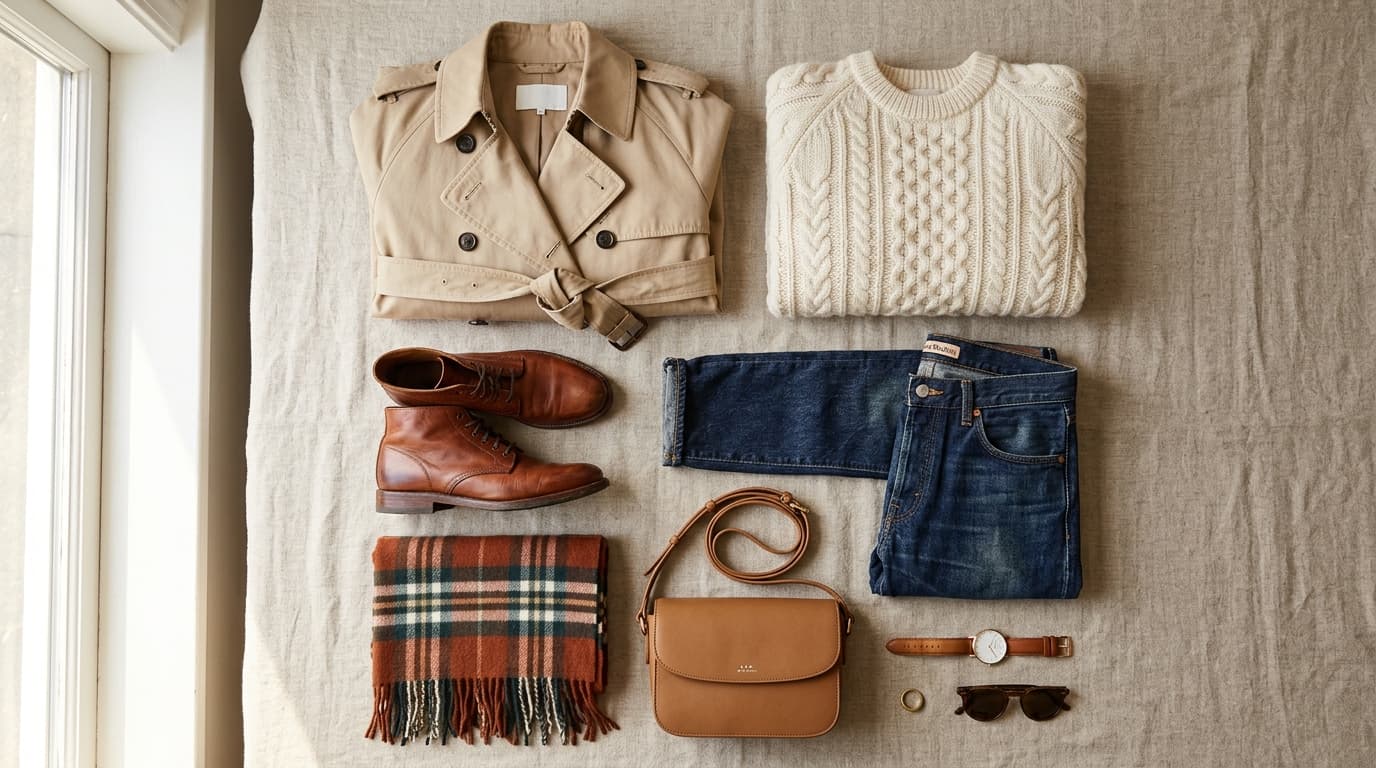
The hard part of autumn is not the cold. It is that one outfit has to cover a cold morning, a mild afternoon, and a cold evening, usually without a chance to go home and change.
Most autumn dressing advice treats the season as a fixed temperature. It is not. It is a range, and the outfit has to move across that range with you.
This guide is about dressing for variability: which pieces adapt, how to layer so you can actually adjust mid-day, what to wear on warm autumn days versus cool ones, and how to move your wardrobe over from summer.
TL;DR
Dress autumn as a temperature range rather than a temperature. Choose pieces that work across several degrees, layer so you can remove and carry a layer easily, and pick shoes and outerwear that handle rain. Slidez lets you try autumn layers on virtually, so you can see how a look works before the weather tests it.
Why Dressing for Changing Autumn Weather Can Be Challenging
Autumn can bring cool mornings and warmer afternoons, especially during clear, dry weather, so a single outfit often has to work across conditions that would normally call for different clothes.
This daily swing between the low and high temperature—the diurnal temperature range—is what makes the season awkward to dress for. As explained by the Met Office, clear skies allow stronger daytime heating and greater overnight heat loss, widening the temperature gap compared to overcast conditions. While the season with the largest swings varies by location—as climatological research in PLOS One notes across different regional stations—clear, dry autumn weather frequently produces these pronounced daily shifts.
The practical effect is that the outfit which feels right at 8am is wrong by 1pm, and wrong again by 6pm. Most people solve this by dressing for one of the three and being uncomfortable for the other two.
The four problems that make autumn harder than it looks:
- The morning-to-afternoon gap: you dress for the coldest part of the day and then carry that decision for twelve hours
- Indoor heating comes on: buildings get warmer at the same time outdoors gets colder, so the two environments diverge
- Rain becomes likely but not certain: carrying for weather that may not arrive is its own problem
- Wind changes everything: the same temperature feels different with wind, and autumn is windier than summer
The solution is not a better single outfit. It is building outfits that can be adjusted without being ruined.
What to Wear in Autumn: Essential Clothing Pieces
The most useful autumn pieces are the ones that work across a temperature range, not the ones that are warmest.
A heavy winter coat is a bad autumn garment because it only works at one end of the range. A mid-weight jacket over a removable knit covers far more of the season.
Pieces that adapt well
- A mid-weight jacket: a trench, field jacket, or chore coat covers most of autumn better than anything heavier
- Cardigans and open knits: easier to remove than a pullover, which matters when you are adjusting mid-day
- A light scarf: adds real warmth at the neck and takes almost no space once removed
- Long-sleeve layers you can push up: a practical half-step between sleeves on and sleeves off
Pieces worth owning for the colder end
- A knit sweater in wool or a wool blend: warmer than cotton for the same thickness and better in damp conditions
- Opaque tights or thermal base layers: extends skirts, dresses, and lighter trousers deeper into the season
- A waterproof or water-resistant outer layer: autumn rain is the most common reason an outfit fails
Pieces that bridge from summer
- Dresses and skirts: autumn-ready with tights, boots, and a jacket over the top
- Short sleeve tops: still useful as base layers under knits and jackets
- Lighter trousers and chinos: work well into autumn with heavier tops and shoes
Fabrics to favor and avoid
- Wool and wool blends: insulate well relative to thickness and handle damp better than most alternatives
- Denim and corduroy: substantial enough to feel seasonal without being warm enough to be limiting
- Cotton with caution: fine as a base layer indoors, less reliable once it gets damp from rain or sweat
- Lined and structured pieces: warmer than their thickness suggests, useful when you want warmth without bulk
For how fabric and fit determine how a piece actually performs, see our guide on how to choose clothes by fit, fabric, and silhouette.
How to Layer Clothes for Changing Autumn Weather
Layer so that removing one piece meaningfully changes how warm you are, and so the removed piece is easy to carry.
This is the difference between autumn layering and winter layering. In winter you add layers and keep them on. In autumn the layers have to come off halfway through the day and go somewhere.
Clothing insulation is measured in clo units, with reference values established in standards like the ASHRAE Handbook—Fundamentals (listing approximately 0.25 clo for a thin long-sleeved sweater and 0.36 clo for a thick sweater or lightweight lined blazer). For near-sedentary indoor activity, predictive thermal comfort modeling by Schiavon and Lee indicates that adding a thin long-sleeved sweater—about 0.25 clo—can lower the optimum operative temperature by roughly 1.5°C (2.7°F). A removable layer therefore offers a practical way to adjust warmth as conditions change, although outdoor comfort also depends on wind, sunlight, and activity.
Build layers you can actually adjust:
Make the middle layer the removable one. Your base stays on and your jacket stays on. The knit or cardigan between them is the piece doing the adjusting, so pick it for how easily it comes off.
Choose a mid layer you can carry. A thin cardigan folds into a bag. A chunky knit does not, which means in practice you will keep it on and be too warm.
Keep the base layer presentable on its own. When the mid layer comes off, the base becomes the outfit. If it only looks right under something else, you have lost the ability to adjust.
Use the neck as a dial. A scarf is the fastest and smallest temperature adjustment available, and it takes up almost no room when removed.
Favor open over pullover. Cardigans, open shirts, and zip layers can be half-adjusted, which a pullover cannot. Opening a layer is often enough without removing it.
Account for indoors separately. If you are inside most of the day, the outer layer is the one that comes off and the rest of the outfit has to work in a heated room.
For the gendered versions of this with specific outfit formulas, see our guides on fall outfits for women and fall outfits for men.
Autumn Outfit Ideas for Warm and Cool Days
Treat warm autumn days and cool autumn days as two different problems, because the pieces that solve them are not the same.
Warm autumn days (roughly 15 to 22°C / 60 to 72°F)
These are summer clothes made seasonal by one addition rather than a full change.
- Summer dress, ankle boots, denim jacket carried not worn. The boots do the seasonal work; the jacket is insurance.
- Short sleeve top, straight jeans, loafers or clean sneakers. Add a light scarf if the morning is cool.
- Lightweight trousers or chinos with a long sleeve shirt, sleeves rolled. Rolling down the sleeves is the whole temperature adjustment.
- Midi skirt, light knit tee, flat boots. Works without tights at this range.
- An overshirt or light jacket over a tee, which reads autumn without adding real warmth.
Cool autumn days (roughly 7 to 15°C / 45 to 60°F)
Here the layers are doing actual work rather than signalling the season.
- Jeans, wool knit, mid-weight jacket, boots. The standard cool-autumn outfit.
- Dress or skirt with opaque tights, tall boots, and a coat. Tights extend these pieces by several degrees.
- Base layer, cardigan, trench or field jacket, boots. Three adjustable stages, which handles a wide swing.
- Trousers, turtleneck, overcoat, leather shoes or boots. Warmth at the neck means less bulk needed elsewhere.
- Layered knits with a scarf, when it is cold but dry enough not to need a proper coat.
Wet autumn days, at any temperature
- Water-resistant outer layer over whatever the temperature calls for: the rain layer and the warmth layer are separate decisions
- Avoid suede footwear: it marks permanently, and autumn is when most suede gets ruined
- Prefer darker colors on the lower half: splashing is unavoidable and shows less
- Shorter hems or cropped trousers: anything that drags gets wet and stays wet
What Shoes and Accessories to Wear in Autumn
Autumn footwear needs a closed toe, a substantial sole, and ideally some water resistance, which rules out most summer shoes regardless of temperature.
Boots are the season's default. Ankle boots are the most versatile and work with nearly everything. Tall boots pair with skirts and dresses and add warmth to the lower leg. A chunkier sole handles wet ground better than a thin one.
Sneakers still work in early autumn. Leather or suede reads more seasonal than canvas, but suede and rain are a bad combination, so choose by the forecast rather than the date.
Loafers and flats bridge the warm end. With socks or tights they stretch further into the season than most people expect.
Avoid anything open-toed or thin-soled once the ground is regularly wet, even on warm days. The temperature is not the deciding factor; the ground is.
Accessories that earn their place:
- A scarf: the single most useful autumn accessory, because it is the fastest adjustment you can make
- A bag you can put a layer into: the practical requirement that makes mid-day adjusting possible
- A hat: useful at the cold end, and it covers hair that rain has already dealt with
- Gloves: for late autumn, and easy to carry before then
- An umbrella or packable rain layer: the difference between an outfit surviving the day or not
For the seasonal styling detail on accessories, see our fall outfit guide for women.
How to Transition Your Wardrobe From Summer to Autumn
Do not swap your wardrobe over in one weekend. Most summer pieces work through autumn with the right additions, and swapping too early leaves you dressed for weather that has not arrived.
The transition is gradual because the weather is. Treating it as a single changeover date is why people end up overdressed in early autumn and underprepared for the warm days that keep appearing into October.
A sensible transition sequence:
- Bring out footwear first. Boots make summer clothes read autumnal immediately, and they handle the ground conditions before the temperature changes.
- Add outerwear second. A light jacket over summer pieces covers most of early autumn without changing anything underneath.
- Introduce tights and base layers third. These extend dresses, skirts, and lighter trousers by several degrees without needing new garments.
- Bring knitwear in fourth. Start with finer knits and cardigans, not the heavy ones.
- Leave heavy coats until last. They are late autumn and winter pieces, and reaching for them early means nothing is left for the cold.
What to actually put away: open-toed shoes, genuinely lightweight fabrics like linen shorts, and anything strappy that cannot take a layer over it. That is a smaller list than most people assume.
What to keep accessible: summer dresses, short sleeve tops, and lighter trousers. All three stay useful well into autumn once they have boots, tights, or a jacket involved.
A useful test before storing anything: can this piece work with boots, tights, or a jacket added? If yes, it is still an autumn garment and should stay out.
For deciding which pieces earn space based on how you actually live, see our guide on how to build a wardrobe around your lifestyle.
How AI Can Help You Plan Autumn Outfits
AI styling helps most with transitional weather, because the question is usually whether a combination works at all, not which of two outfits you prefer.
Whether a summer dress genuinely works with boots and a jacket, or whether a coat length suits a skirt you already own, is hard to judge from imagination or from separate product photos.
Slidez lets you try layered autumn looks on virtually, on your own body. Its AI stylist analyzes your body type from your photo automatically, so proportions account for your frame rather than a model's.
Where this is useful in autumn specifically:
- Testing summer pieces in autumn layers: before deciding whether to store something
- Checking layer and coat proportions: lengths that work together, judged before buying
- Validating a transitional purchase: a jacket is only worth it if it works over what you own
- Shopping across stores: the Chrome extension works on any online store
Looks save and sync between phone and desktop, which makes it practical to plan a week of variable-weather outfits in one sitting.
Conclusion
Autumn dressing works when you stop treating the season as a temperature and start treating it as a range. Choose pieces that span several degrees, make your middle layer the one that comes off, carry a rain layer, and let boots do the seasonal work while the weather catches up.
The wardrobe transition should be gradual too. Footwear, then outerwear, then base layers, then knitwear, with heavy coats last.
Slidez helps with the part that is hardest to picture. Try autumn layers on virtually, see how a combination sits on your own body, and check a transitional piece against your wardrobe before buying. The free version includes all core features.
Ready to plan for the weather? 👉 Download Slidez free.
Frequently Asked Questions (FAQs)
What should I wear in autumn?
Dress for a temperature range rather than a single temperature. A base layer that looks fine on its own, a removable knit or cardigan in the middle, and a mid-weight jacket covers most autumn days across the morning-to-afternoon swing.
Add boots, and a scarf you can take off easily. Slidez can show you how these combinations look on your own body before you commit to any of them.
How do I dress for changing autumn weather?
Build the outfit so one piece can come off without ruining it. Make the middle layer the adjustable one, keep the base layer presentable by itself, and choose a mid layer thin enough to fold into a bag.
A scarf is the fastest small adjustment available, and an open cardigan or zip layer can be half-opened rather than fully removed, which is often enough.
What clothes are essential for an autumn wardrobe?
The most useful autumn pieces work across a range rather than at one extreme: a mid-weight jacket, cardigans and open knits, a wool or wool-blend sweater, opaque tights or base layers, a water-resistant outer layer, and ankle boots.
A heavy winter coat is less useful than it seems, because it only works at the coldest end of the season.
How do you layer clothes for autumn?
Use three stages: a base layer, a removable middle layer, and an outer layer. The middle one does the adjusting, so pick it for how easily it comes off and how small it folds.
Keep the base layer good enough to wear alone, since it becomes the whole outfit once the middle layer is off, and account for indoor heating separately if you are inside most of the day.
What should I wear on warm autumn days?
Keep your summer pieces and make them seasonal with one addition. A summer dress with ankle boots, a short sleeve top with jeans and loafers, or lightweight trousers with a long sleeve shirt all work in the 15 to 22°C range.
Carry a light jacket rather than wearing it, and add a scarf if the morning starts cool. Rolling sleeves up and down handles a surprising amount of the adjustment.
What shoes are best for autumn outfits?
Closed-toe shoes with a substantial sole. Ankle boots are the most versatile and work across jeans, trousers, skirts, and dresses; tall boots add warmth for skirts and dresses in colder weeks.
Leather sneakers work in early autumn, and loafers or flats bridge the warm end with socks or tights. Avoid suede when rain is forecast, since autumn is when most suede gets ruined.
Can AI help me create autumn outfit combinations?
Yes, and transitional weather is where it helps most, since the question is usually whether a layered combination works at all.
Slidez lets you try autumn layers on virtually and factors your body type into recommendations automatically. It is useful for testing whether summer pieces still work with boots and a jacket before you store them.
Ready to see autumn layers on yourself first? 👉 Download Slidez free.
References
- What is diurnal temperature range and why it changes as we move into spring, Met Office, March 2026
- Diurnal temperature range: A climatological primer for health researchers, Davis et al., PLOS One, July 2026
- ASHRAE Handbook—Fundamentals, Chapter 9: Thermal Comfort (Table 9: Garment Insulation Values), ASHRAE, 2025
- Dynamic predictive clothing insulation models based on outdoor air and indoor operative temperatures, Stefano Schiavon and Kwang Ho Lee, Building and Environment, January 2013