
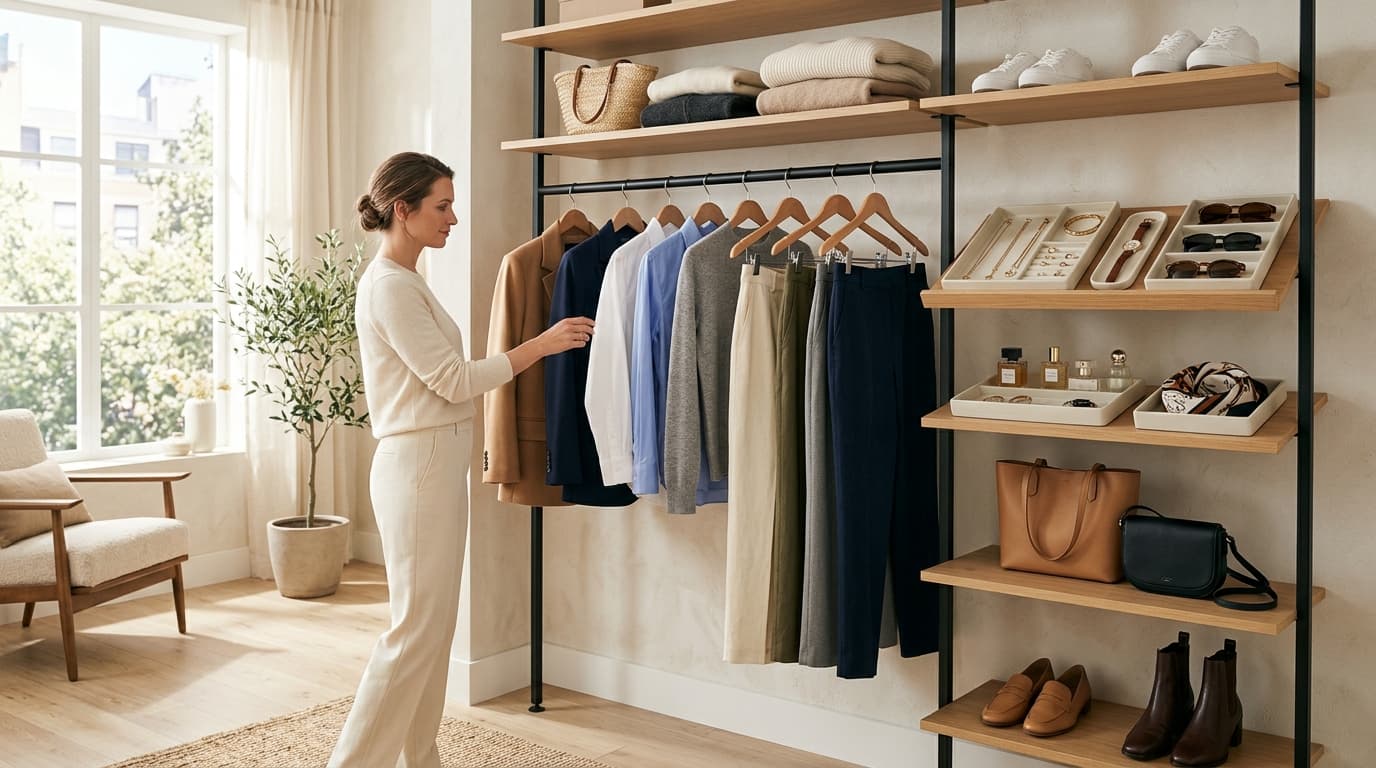
A wardrobe can be full and still be wrong. Plenty of closets are packed with clothes for a job the owner no longer has, a social calendar that never materialised, or a climate they do not actually live in.
A wardrobe built around your lifestyle fixes the mismatch. It is less about the number of pieces you own and more about whether those pieces match the life you are actually living, not the one you imagined when you bought them.
This guide covers how to assess your real needs, build functional categories around them, and avoid the planning mistakes that lead right back to a closet full of clothes with nowhere to go.
TL;DR
A lifestyle wardrobe is built from an honest audit of how you actually spend your time, rather than a fixed piece count or a minimalist ideal. Assess your real needs, build categories around them, and check every purchase against your actual calendar. Slidez helps by generating outfits for the real occasions in your life and showing them on you before you buy.
What Does It Mean to Build a Wardrobe Around Your Lifestyle?
Building a wardrobe around your lifestyle means stocking your closet based on how you actually spend your time, not on an idealised or aspirational version of your life.
The gap between the two is where most unworn clothes come from. A wardrobe built for the job you want, the social calendar you wish you had, or the climate you used to live in will always underperform, however well it is organised.
This is a different goal from minimalism. A lifestyle wardrobe can be large or small. What matters is accuracy, not size.
Someone who works from home, exercises daily, and rarely attends formal events needs a completely different wardrobe from someone commuting to an office five days a week, and neither is more "correct" than the other.
How to Assess Your Lifestyle and Clothing Needs
Everything starts with an honest inventory of your actual life, not your intended one.
Map your week. List what you actually do, day by day, for a typical week and a less typical one. Work, exercise, errands, social time, downtime. This is your real demand for clothing.
Count your recurring contexts. Organize your wardrobe around the recurring parts of your life, such as work, casual days, exercise, and evenings out, alongside any specialized needs like travel or a hobby. As professional organizer Jane Stoller outlines in Real Simple, grouping clothing by lifestyle and routine rather than rigid rules helps ensure every category reflects how you actually spend your time.
Be honest about frequency. A formal event you attend once a year needs one outfit, not five. A context you are in daily deserves proportionally more of your wardrobe and budget.
Account for your actual climate. Build for the weather you experience most, not an idealised four-season wardrobe if you live somewhere with two real seasons.
Note what is missing right now. The moments you have felt stuck for something to wear are the clearest evidence of where your current wardrobe does not match your life.
How to Choose Clothes for Work, Social Events, and Everyday Life
Once your real categories are mapped, build each one deliberately rather than accumulating pieces at random.
Work. Build around your workplace's actual norm, not a generic ideal. Business casual is now the most common office dress code, so confirm what your specific environment expects before over-investing in formality you do not need.
Social events. A handful of versatile pieces that can be dressed up or down covers most casual social occasions. Reserve dedicated formal pieces only for the frequency you actually attend formal events.
Everyday and errands. This category gets the least attention and the most actual wear. Comfortable, durable, easy pieces deserve real investment, not leftover budget after other categories are covered.
Active or specialised needs. If a genuine recurring activity exists, exercise, a hobby, travel, build a small, purpose-specific set rather than making general clothing do double duty poorly.
For occasion-specific dress code guidance, see our guide on what to wear for every occasion.
How to Balance Comfort, Style, and Functionality
The best lifestyle wardrobes do not sacrifice one of these for the others. They are negotiated together.
Start from function, then layer in style. A useful wardrobe needs to support your daily activities while reflecting your identity. As designers and stylists highlighted in Who What Wear, a versatile wardrobe successfully balances practical staples for different settings with expressive pieces that preserve your individuality. At Slidez, we recommend a two-layer approach informed by this advice: choose pieces that function comfortably for your routine first, then express your personal style through their colors, silhouettes, textures, and styling.
Comfort is not the opposite of style. Well-fitting, quality fabric is both more comfortable and more flattering than ill-fitting clothing in a technically "nicer" fabric.
Match fabric to activity level. A desk job and a physically active day have different comfort requirements, and the fabric choice should reflect that rather than defaulting to the same materials across every category.
Style should follow your established taste. A lifestyle wardrobe still benefits from a consistent personal style running through it. Practical function clarifies which categories and garments you need, while personal taste defines how you fill and personalize them.
For the process of identifying your own style, see our guide on what personal style is and how to find yours.
How to Choose the Right Wardrobe Essentials
Essentials are the pieces that appear across multiple categories, carrying disproportionate weight for their number.
Identify your cross-category pieces first. A well-fitting blazer, a quality pair of trousers, or a versatile dress that works for both work and social contexts deserves priority over single-purpose items.
Invest more in your highest-frequency category. The more often you wear an item, the lower its cost per wear (purchase price ÷ number of wears). As peer-reviewed research in Psychology & Marketing demonstrates, evaluating clothing through cost per wear increases preference for higher-quality clothing when the indicated cost per wear is lower. Frequently worn everyday pieces can therefore justify a higher upfront budget—provided their durability and realistic wear count make the purchase worthwhile—whereas low-frequency occasion pieces rarely justify substantial spending.
Choose neutral foundations, colourful accents. A coordinated base of neutrals extended by a smaller set of colour accents produces more usable combinations than an evenly colourful wardrobe.
Fill true gaps, not perceived ones. A gap is something your actual calendar requires and your current wardrobe cannot cover. Everything else is a want, which is fine to pursue deliberately but should not be confused with a need.
How to Build a Wardrobe That Works for Different Occasions
A lifestyle wardrobe should flex across occasions without needing a separate wardrobe for each one.
Build versatile anchor pieces. A blazer that moves from work to a dinner, a dress that works with flats for day and heels for evening, gets more use than single-occasion pieces.
Layer for range. Two or three layering pieces (a cardigan, a jacket, a structured coat) multiply the number of occasions your base pieces can cover.
Keep one or two dedicated formal pieces. Even an otherwise casual lifestyle usually has occasional formal needs. One well-chosen outfit covers this without requiring an entire formal wardrobe.
Plan ahead for predictable occasions. If your calendar has a recurring category, a monthly work dinner, a weekly activity, build a small rotation specifically for it rather than improvising each time.
For more on digitising and organising the result, see our guide on the complete guide to creating a smart digital wardrobe.
Common Wardrobe Planning Mistakes to Avoid
A handful of recurring mistakes undermine an otherwise sound plan.
Building for an aspirational life. Buying for an imagined future lifestyle—the job, body, or social calendar you hope for rather than the one you actually live—can leave purchases underused when expected activities or occasions do not materialize. Doctoral research from Carnegie Mellon University on aspirational purchasing found that items bought for a hoped-for future self (such as special-occasion eveningwear for events that never occur) are particularly prone to underuse and diminished buyer satisfaction.
Treating every category equally. A wardrobe split evenly across contexts you rarely enter wastes budget on your lowest-frequency needs.
Skipping the audit step. Buying new pieces without checking what you already own leads to duplicates and overlooked gaps.
Chasing a fixed piece count. Rigid numbers (exactly 30 items, exactly 10 outfits) matter less than whether your wardrobe actually covers your real contexts.
Ignoring climate reality. Building a wardrobe around an idealised four distinct seasons when your actual climate does not support it leads to pieces that sit unused most of the year.
Never revisiting the plan. Lifestyles change. A wardrobe built around last year's job or routine needs a periodic recheck against your current one.
Conclusion
A wardrobe built around your lifestyle starts with an honest audit of how you actually spend your time, not the life you imagined when you went shopping.
From there, building deliberate categories, investing more in your highest-frequency needs, and checking every purchase against your real calendar does most of the remaining work.
Slidez supports this directly. It generates outfit recommendations for the real occasions in your life, analyses your body automatically during styling, and shows every suggestion through virtual try-on before you commit. The free version includes all core features.
Ready to build a wardrobe that matches your actual life? 👉 Download Slidez free.
Frequently Asked Questions (FAQs)
How do I build a wardrobe around my lifestyle?
Start with an honest map of how you actually spend your time: work, social, active, casual, and any specialised needs.
Build each category based on real frequency rather than an idealised version of your life, then prioritise versatile pieces that work across more than one category.
Revisit the plan periodically, since lifestyles and routines shift over time.
How many clothes should I have in my wardrobe?
There is no fixed correct number. The right size depends entirely on how many distinct contexts your actual life requires and how often you want to do laundry. A lifestyle wardrobe is judged by whether it covers your real needs, not by hitting a specific item count.
Someone with a simple, low-variation routine may need far fewer pieces than someone navigating several distinct contexts weekly, and both can be equally well planned.
What are the essential pieces for an everyday wardrobe?
Essentials are the pieces that work across multiple contexts: well-fitting neutral basics, one or two versatile layering pieces, and footwear that transitions between settings. These carry disproportionate value relative to single-occasion items.
The specific essentials vary by lifestyle, but the principle is consistent: prioritise pieces your actual routine will use most often.
How do I choose clothes that fit my lifestyle?
Map your real week first, then choose pieces for the contexts that actually appear in it, weighted by how often each occurs. A formal piece worn once a year deserves far less wardrobe space and budget than everyday pieces worn constantly.
Checking new purchases against this map, rather than buying based on appeal alone, is the most reliable way to keep a wardrobe aligned with your actual life.
How can I build a wardrobe without buying unnecessary clothes?
Audit what you already own before adding anything new, and only buy for gaps your actual calendar requires rather than ones you imagine. A piece should pass a simple test: does a specific, real context in your life need this.
Checking coordination with your existing wardrobe before purchasing also prevents the orphan purchases that go unworn.
What is the difference between a lifestyle wardrobe and a capsule wardrobe?
A capsule wardrobe is primarily about minimalism and combinatorics: a small, fixed set of versatile pieces chosen to maximise outfit combinations.
A lifestyle wardrobe is primarily about accuracy: whether your clothing matches how you actually spend your time, regardless of how large or small it is.
The two overlap often, since a wardrobe built accurately around a genuinely simple lifestyle may naturally end up small, but they are not the same goal. For more on the capsule approach specifically, see our guide on building a capsule wardrobe with AI styling tools.
Can AI help me plan my wardrobe?
Yes. AI styling tools can generate outfit recommendations tailored to your real occasions, learn which combinations you actually use, and show new pieces on your body before you commit to buying them.
Slidez analyses your body automatically during styling and lets you try on potential purchases virtually, which helps confirm a piece genuinely fits your lifestyle before it joins your wardrobe.
Ready to build a wardrobe that matches your actual life? 👉 Download Slidez free.
References
- 8 Closet Organizing Rules That Are Actually Working Against You, Real Simple, November 2025
- Ultimate Capsule Wardrobe Items, According to Fashion Experts, Who What Wear, March 2025
- Shifting Toward Quality: How Communicating ‘Cost per Wear’ Influences Consumer Preference for Clothing, Psychology & Marketing, 2025/2026
- Aspirational Purchases (Essays on the Consumer Journey of Goal Planning and Goal Pursuit), Carnegie Mellon University, April 2025