Menswear does not change shape much between seasons. A shirt is a shirt, trousers are trousers, and the silhouette stays roughly constant year round.
What changes in fall is texture and weight. The same outfit built in flannel, wool, and suede reads completely differently from the summer version in poplin and cotton, without altering a single proportion.
This guide covers the pieces worth owning, outfit ideas for everyday and for occasions, how to layer without adding bulk, and the shoes and accessories that finish a fall look.
TL;DR
Fall menswear is about fabric weight and texture rather than new silhouettes. Build on flannel, wool, denim, and knitwear in a tight earth-tone palette, layer thin to thick to avoid bulk, and anchor with leather or suede boots. Slidez lets you try fall layers on virtually before buying, so you can see how they sit on your own frame.
Why Fall Is a Great Season for Men's Fashion
Fall gives menswear its widest range of texture and fabric, which is where men's outfits get most of their visual interest.
Summer menswear is constrained. Lightweight fabrics, fewer layers, and a limited palette mean most outfits end up looking similar. Fall removes that ceiling.
Flannel, tweed, corduroy, suede, waxed cotton, waffle knit, and heavy denim all become wearable at once, and they combine with each other well. An outfit with three different textures in it holds attention in a way three different colors rarely does.
What the season makes available:
- Texture as the main variable: interest comes from the materials, not from louder colors or unusual cuts
- Layering as an outfit multiplier: a shirt that was a complete outfit in summer becomes one element of three
- A palette that coordinates by default: olive, brown, rust, navy, charcoal, and cream work with each other without much planning
- Outerwear finally matters: a good jacket does more for a fall outfit than anything underneath it
The practical consequence: a fairly small wardrobe produces a lot of distinct outfits, as long as the pieces share a palette and differ in texture.
For more on how fabric and fit drive how clothes read, see our guide on how to choose clothes by fit, fabric, and silhouette.
Essential Clothing Pieces for Men's Fall Outfits
A working fall wardrobe is roughly a dozen pieces, chosen so every top layers over at least two things and under at least one.
Fabric weight—usually expressed in GSM or ounces per square yard—is one useful guide to seasonal suitability. Thickness, construction and the air a fabric retains also affect its insulation, so weight alone cannot tell you how warm a garment will feel. As textile research published in the Journal of Natural Fibers indicates, fabric mass and thickness strongly influence thermal resistance, though construction and trapped air also play major roles. While test standards such as ASTM D3776 define mass per unit area without setting seasonal boundaries, comparing verified examples provides a practical benchmark: experimental shirting often sits between 103 and 116 GSM, commercial suiting fabrics frequently span 145 to 250 GSM, while flannel shirts (often 5–6.4 oz/yd², or ~170–217 GSM) and bottom-weight denim (8–16.5 oz/yd²) provide the substantial hand feel suited to cooler weather.
Shirts and base layers
- Flannel shirts: the defining fall shirt, works alone or as a light layer over a tee
- Oxford cloth button-downs: heavier than poplin, layers cleanly under knitwear
- Plain tees in neutral colors: the base for most casual layering
- A long-sleeve henley or waffle knit: texture at the base layer, works alone on milder days
Knitwear
- A merino or lambswool crewneck: the most versatile fall layer, smart enough for work
- A chunky knit or shawl collar cardigan: heavier, more casual, good over a shirt
- A quarter-zip or mock neck: sits well under a jacket without a collar conflict
Outerwear
- A field jacket or chore coat: the fall workhorse, casual and structured at once
- A denim or leather jacket: shorter, pairs with nearly everything
- A wool overcoat or topcoat: for late fall and for anything dressier
- A quilted or waxed jacket: handles rain better than wool and reads properly seasonal
Trousers
- Dark and mid-wash denim: straight or slim-straight covers most casual wear
- Chinos in olive, stone, or brown: slightly sharper than jeans, still casual
- Wool or flannel trousers: moves an outfit toward work or evening
- Corduroy trousers: texture on the bottom half, which fall allows and other seasons do not
Footwear
- Leather or suede boots: chelsea, chukka, or a derby boot covers almost everything
- Clean leather sneakers: keeps casual outfits from getting heavy
- A pair of loafers or derbies: for work and dressier occasions
For building this around your actual week rather than an idealized one, see our guide on how to build a wardrobe around your lifestyle.
Casual Fall Outfit Ideas for Men
Casual fall outfits work best with two or three textures in a tight color range, built on denim or chinos.
These handle weekends, casual offices, and most of everyday life without much thought.
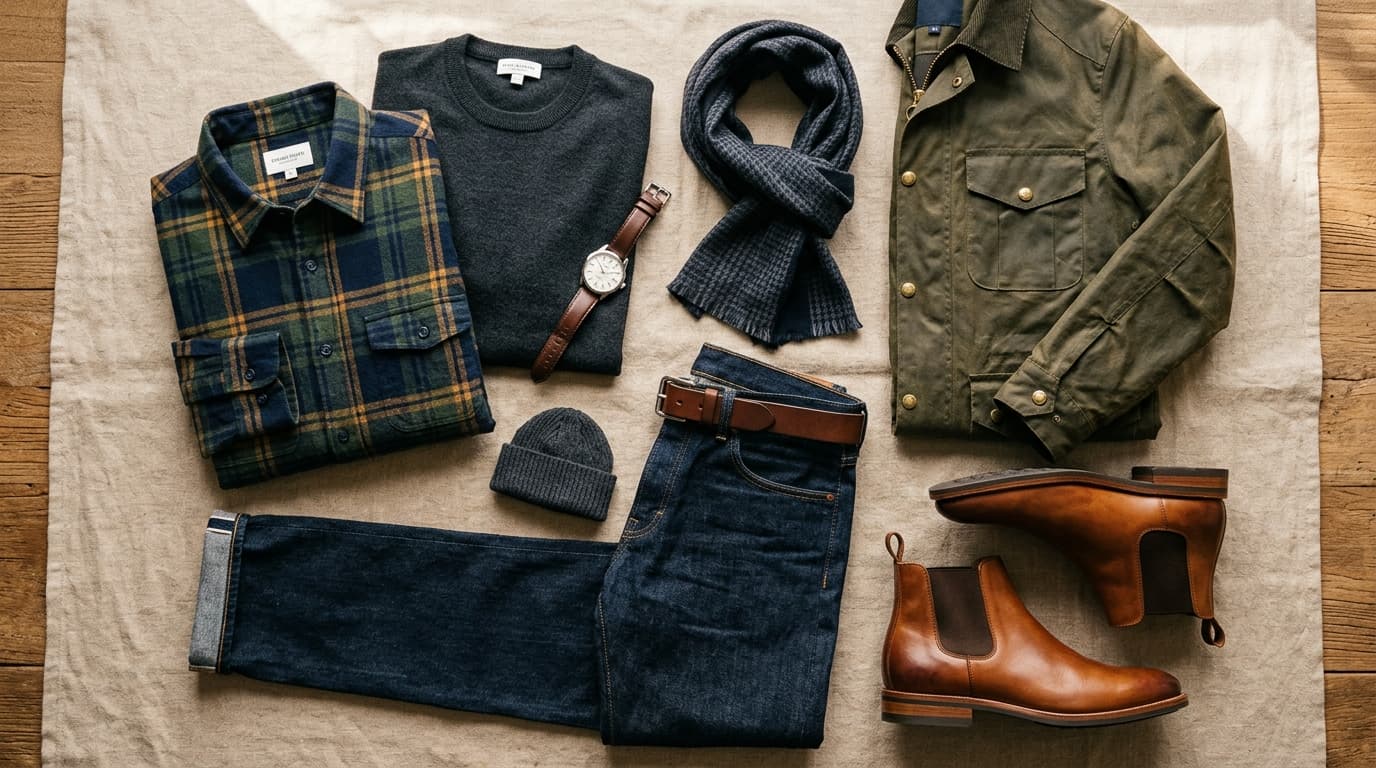
- Flannel shirt, plain tee underneath, dark jeans, chelsea boots. The default casual fall outfit. Leave the flannel open or button it depending on temperature.
- Merino crewneck over an oxford shirt, chinos, leather sneakers. Collar and cuffs showing under the knit is the detail that makes it work.
- Field jacket, henley, straight jeans, chukka boots. Three textures, one palette, no effort.
- Chunky cardigan over a tee, corduroy trousers, boots. Heavier and more relaxed, good for colder weekends.
- Denim jacket over a hoodie, chinos, clean sneakers. Casual layering that still looks assembled rather than thrown on.
- Quarter-zip knit, dark jeans, derby boots. The simplest option when you want to think about it least.
- Waxed jacket, flannel shirt, olive chinos, work boots. The most seasonal of the set, and it handles weather.
The adjustment that improves most of these: let the base layer show. A shirt collar above a crewneck, or a shirt hem below a jacket, adds a visible line that stops layered outfits from reading as one solid block.
Fall Outfit Ideas for Work, Dates, and Special Occasions
The same fall pieces move between contexts by changing the outer layer and the shoes, not the whole outfit.
Work and professional settings
- Merino crewneck over a shirt, wool trousers, derbies or loafers: polished without needing a blazer
- Blazer over a fine knit, with chinos or wool trousers: the layer does the formality work
- Oxford shirt, quarter-zip, tailored trousers, leather boots: smart casual that handles a cold office
- Topcoat over any of the above: the single piece that makes a work outfit look finished
Date nights
- Leather jacket, plain knit, dark denim, chelsea boots: the contrast between soft knit and structured leather is what carries it
- Shawl collar cardigan, oxford shirt, dark chinos, boots: warmer and less expected than a jacket
- Monochrome layering in one color family, navy or charcoal throughout, which reads deliberate
Weddings, events, and dressier occasions
- A wool suit in a seasonal tone: charcoal, navy, or brown, with a heavier fabric than a summer suit
- Tweed or flannel jacket with wool trousers, for events that are dressy but not formal
- A topcoat over the suit rather than a casual jacket, which is the difference between dressed and dressed-up
- Leather oxfords or a polished derby boot, which suit fall weather better than thin-soled dress shoes
The formality lever in menswear fall is almost always the outer layer. A field jacket over a shirt and trousers is casual; a topcoat over the same shirt and trousers is not.
For dress codes by event type, see our guide on what to wear for every occasion.
How to Layer Clothes for Stylish Fall Outfits
Layer thin to thick from the inside out, and manage the collar, shoulders, and hems, since those are where men's layered outfits usually go wrong.
Layering can improve insulation by retaining still air within fabrics and between garments. Several thin layers are not automatically warmer than one thick garment: their performance depends on the total thickness, retained air and how much the layers are compressed. As peer-reviewed research in Materials explains, trapped still air (with ambient thermal conductivity around 0.026 W/(m·K)) provides the primary insulating mechanism, and mechanical compression reduces that thermal resistance. Earlier experimental research in Applied Energy similarly showed that under compressive load, multilayer assemblies behave essentially like a single layer of equivalent thickness. In menswear, layering remains practically useful because you can adjust individual layers as temperatures change across the day while keeping your silhouette clean.
Bulk is the main failure mode in menswear layering. Men's outerwear is cut closer through the shoulders and chest than womenswear, so a heavy mid layer under a fitted jacket pulls the whole thing out of shape.
The rules that keep layering clean:
Thinnest layer closest to the skin. A bulky base makes everything above it sit badly, and it cannot be fixed by sizing up the jacket.
Check the shoulders before anything else. If a jacket's shoulder seam is pushed off-position by what is underneath, the mid layer is too heavy for that jacket. This is the most visible layering mistake and the easiest to miss in a mirror.
Manage the collar stack. A shirt collar under a crewneck looks deliberate. A shirt collar fighting a jacket collar and a scarf does not. Pick one collar to be visible.
Vary the hem lengths. A shirt hem below a sweater, a jacket longer than both. Layers ending at the same point create a solid block with no visible structure.
Keep sleeve lengths in order. Each successive layer should end at or before the one beneath it. A sweater sleeve swallowing a shirt cuff looks like a sizing error.
Stay inside a tight palette. Two or three colors across four layers. Earth tones and neutrals make this easy in fall, which is part of why the season is forgiving.
Let texture do the differentiating. Smooth shirt, ribbed knit, waxed jacket. Three textures in one color family looks considered; three patterns does not.
Best Shoes and Accessories for Men's Fall Outfits
Fall footwear should be leather or suede with a substantial sole, and accessories should stay functional rather than decorative.
Boots are the season's anchor. Chelsea boots are the most versatile and work with jeans, chinos, and wool trousers alike. Chukkas are lighter and more casual. A derby or service boot handles weather and reads more rugged. One good pair in brown suede or leather covers most of fall.
Sneakers still work, but choose leather. Canvas reads summer. A clean leather or suede sneaker keeps a casual outfit light without looking out of season.
Dress shoes need the right sole. A leather-soled oxford is uncomfortable in wet weather. A rubber or Dainite sole on a derby or boot gives the same formality with better grip.
Accessories worth having:
- A wool or cashmere scarf: the most useful fall accessory, and the one that adds most visible texture
- A leather belt that matches your boots: the simplest way to make an outfit look coordinated
- A watch with a leather or canvas strap: warmer in tone than a steel bracelet, which suits fall palettes
- Leather gloves: for late fall, and they finish a topcoat properly
- A beanie or flat cap: one at a time, and let it be the only attention-grabbing piece
A bag that matches the formality. A leather or waxed canvas holdall works with casual fall outfits. A structured briefcase or leather tote suits the work versions.
The rule that applies across all of it: match your leathers. Belt, boots, watch strap, and bag in roughly the same tone is the detail that separates a put-together fall outfit from a collection of good pieces.
How AI Can Help Men Plan Fall Outfits
AI styling helps most with fall layering, because the thing that goes wrong (bulk and proportion) is hard to judge before you are wearing all the layers at once.
Whether a mid layer works under a particular jacket, or whether a coat length suits your height, is difficult to predict from a product photo of each piece separately.
Slidez addresses this by letting you try layered looks on virtually, on your own body. Its AI stylist analyzes your body type from your photo automatically, so the proportions it suggests account for your actual frame.
Where this helps in fall specifically:
- Testing layer combinations: whether a knit sits cleanly under a jacket you already own
- Checking outerwear proportions: coat and jacket lengths relative to your height before committing
- Validating a seasonal purchase: a new flannel or boot only earns its place if it works with existing pieces
- Shopping across stores: the Chrome extension works on any online store, useful when fall pieces come from different brands
Looks save and sync between phone and desktop, which makes it practical to plan a season's rotation in one sitting.
For the women's version of this guide, see our fall outfit ideas for women.
Conclusion
Men's fall dressing is a fabric problem more than a styling problem. Get the weights and textures right, keep the palette tight, layer thin to thick without breaking the shoulder line, and anchor everything with good boots.
A dozen well-chosen pieces produce most of the season once they share a palette and differ in texture.
Slidez takes the guesswork out of the layering part. Try fall looks on virtually, check how layers sit on your own frame, and confirm a piece works with your wardrobe before buying. The free version includes all core features.
Ready to plan your fall rotation? 👉 Download Slidez free.
Frequently Asked Questions (FAQs)
What are the best fall outfit ideas for men?
The most reliable fall outfits combine two or three textures in a tight color range: a flannel shirt over a tee with dark jeans and chelsea boots, a merino crewneck over an oxford shirt with chinos, or a field jacket over a henley with straight jeans.
These work because each layer can be swapped independently, so a small wardrobe produces many outfits. Slidez can show you how these combinations look on your own body before you buy anything.
What should men wear during fall?
Focus on fabric weight rather than new silhouettes. Flannel, wool, corduroy, suede, and heavier denim in earth tones and neutrals handle most of the season across casual and work settings.
Build outfits in layers you can remove as the day warms, and let the outer layer set the formality. A field jacket reads casual; a topcoat over the same outfit reads dressed.
What are the essential pieces for a men's fall wardrobe?
The core set is a flannel shirt, an oxford button-down, a merino crewneck, a chunky cardigan or quarter-zip, a field or chore jacket, a denim or leather jacket, a wool overcoat, dark denim, chinos, and leather or suede boots.
Add wool trousers and a tweed or flannel jacket if you need work or occasion options. A useful test: every top should layer over at least two things you own and under at least one.
How do men create stylish casual fall outfits?
Use texture rather than color to create interest. A smooth oxford shirt, a ribbed knit, and a waxed jacket in one color family looks considered, while three competing patterns rarely does.
Let the base layer show. A shirt collar above a crewneck or a shirt hem below a jacket adds a visible line that stops layers from reading as one solid block.
How should men layer clothes for fall weather?
Layer thin to thick from the inside out. Layering can improve insulation by retaining still air within fabrics and between garments, though several thin layers are not automatically warmer than one thick garment—their thermal performance depends on total thickness, retained air, and how much the garments are compressed.
Check the shoulders first. If a jacket's shoulder seam is pushed out of position by the layer underneath, that mid layer is too heavy for that jacket. Also keep sleeve and hem lengths in descending order so each layer ends at or before the one beneath it.
What shoes go best with men's fall outfits?
Leather or suede boots with a substantial sole are the season's anchor. Chelsea boots are the most versatile across jeans, chinos, and wool trousers; chukkas are lighter and more casual; a derby or service boot handles weather better.
Clean leather sneakers keep casual outfits from getting heavy, and for dressier occasions a rubber-soled derby or boot gives the formality of a dress shoe with better grip in wet weather.
Can AI help men create fall outfit combinations?
Yes, and layered outfits are where it helps most, since bulk and proportion are hard to judge until you are wearing every layer at once.
Slidez lets you try layered fall looks on virtually and factors your body type into its recommendations automatically, so you can check whether a knit works under a jacket before buying either.
Ready to see fall layers on yourself first? 👉 Download Slidez free.
References
- The Effect of Fabric Structural Parameters and Fiber Type on the Comfort-Related Properties of Commercial Apparel Fabrics, Marguerite Ester Stoffberg, Lawrance Hunter, and Anton Botha, Journal of Natural Fibers, October 2015
- ASTM D3776/D3776M-20(2025): Standard Test Methods for Mass Per Unit Area (Weight) of Fabric, ASTM International, 2025 Reapproval
- Measurement Methods of the Thermal Resistance of Materials Used in Clothing, Materials, 16(10), 3842, May 2023
- Thermal Resistance Behaviour of Single and Multiple Layers of Clothing Fabrics Under Mechanical Load, P. W. O'Callaghan and S. D. Probert, Applied Energy, January 1977
- Effects of Usage Acrylic Yarn on Thermal Comfort and Moisture Management Properties of Woven Shirting Fabrics, Tekstil ve Konfeksiyon (Textile and Apparel), June 2018
- Denim Basics: Construction, Weights and Applications, CottonWorks™ by Cotton Incorporated