
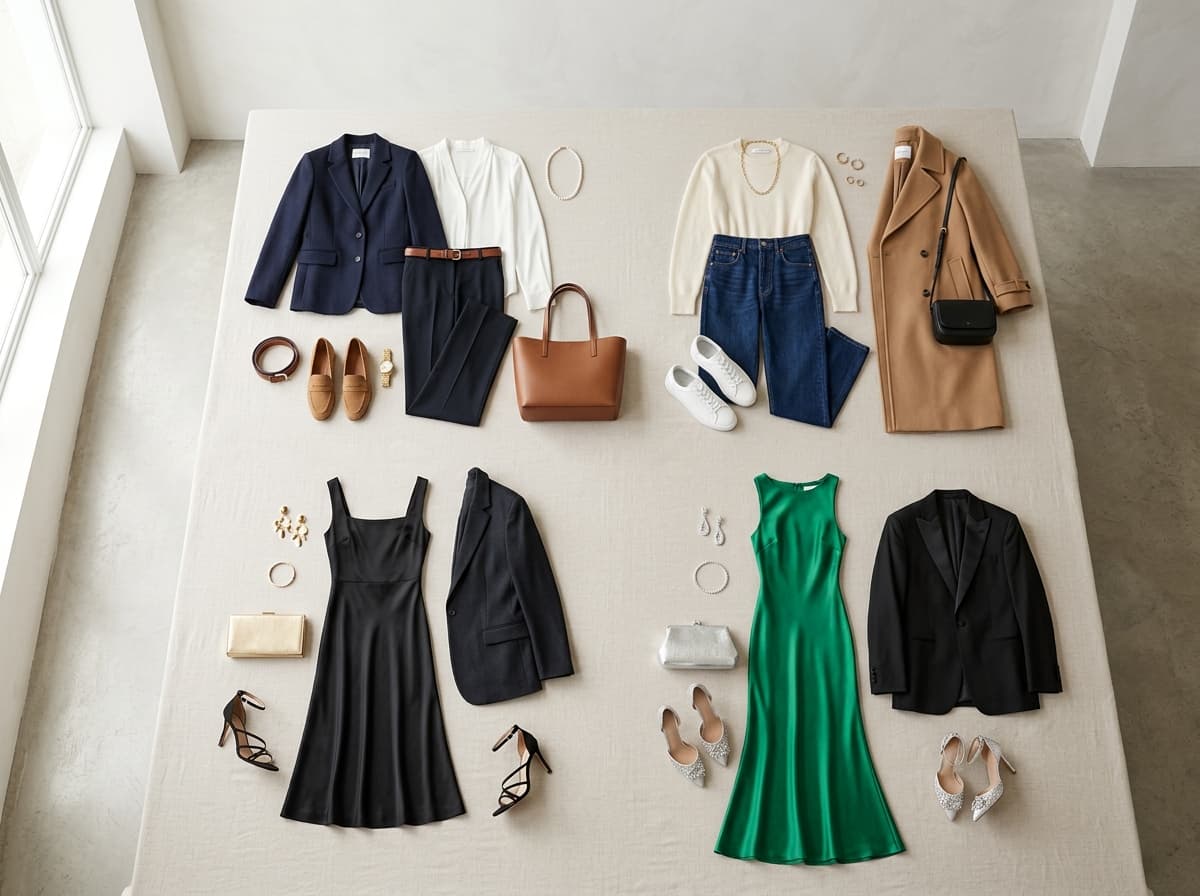
Every occasion carries an unwritten dress code, and the anxiety of getting dressed usually comes from not being sure what it is. Overdressed feels awkward. Underdressed feels worse. And the rules shift depending on the event, the venue, the season, and the crowd.
This guide lays out what actually works for the occasions people dress for most, from the office to a black-tie wedding. It also covers how an AI outfit planner takes the guesswork out of matching your wardrobe to the moment.
TL;DR
Different occasions call for different levels of formality, coverage, and tone. This guide breaks down what to wear for work, casual, and special events, and shows how an AI outfit planner like Slidez builds an appropriate look for any occasion and shows it on you before you commit.
Why Choosing the Right Outfit Can Be Challenging
Dressing for an occasion is rarely just about taste. Several things make it genuinely hard:
Dress codes are vague
“Smart casual” and “cocktail” mean different things to different people, and getting them wrong is easy without clear reference points.
Context shifts the rules
The same event outdoors in summer and indoors in winter calls for different clothes entirely, altering fabrics, layering structures, and footwear options.
You cannot see your whole wardrobe
Standing in front of a full closet, most people forget what they own, so good options go unused. WRAP's 2022 UK study found that around 26% of the average wardrobe goes entirely unworn across a full year, driven heavily by a lack of visibility rather than by fit or wear.
Decision fatigue is real
Getting dressed is one of the first decisions of the day, and the mental effort adds up, especially before a high-stakes event. Foundational research by Baumeister et al. established that the capacity for decision-making draws on a finite cognitive resource, so repeated choices leave less mental energy for what follows.
Fit is unpredictable
A piece that looked right in a photo may not sit the same way on you, which matters most when the occasion matters most.
An outfit planner addresses all five, because it holds your wardrobe, the occasion, and your body in view at once.
What to Wear for Work and Professional Settings
Workwear runs along a spectrum from formal to relaxed, and the right point depends on your industry and workplace.
Business casual is the most common office dress code: Gallup's 2023 poll found that 41% of US workers wear it, while just 3% wear traditional business professional attire.
Business Formal
The most conservative office standard. A tailored suit or a coordinated blazer with trousers or a skirt, a crisp shirt, and clean leather shoes. Common in law, finance, and executive settings.
Business Casual
The default in most modern offices. Chinos or tailored trousers with a button-down or knit, often layered with a blazer or cardigan. Polished but comfortable.
Smart Casual
For creative and relaxed workplaces. Dark, well-fitting jeans or tailored chinos with a structured top and elevated shoes, such as loafers or clean minimalist leather sneakers.
Job Interviews
Aim one notch above the everyday dress code of the company you are interviewing with. When unsure, err slightly formal with crisp tailoring and neutral palettes.
The advantage of planning workwear is consistency. A coordinated rotation of pieces means every workday outfit is decided in advance and always appropriate.
What to Wear for Casual Everyday Outfits
Casual is the hardest category to get right precisely because it has the fewest rules. Without a dress code to anchor it, casual can drift into careless.
Everyday Casual
Well-fitting jeans or relaxed trousers, a quality tee or knit, and clean sneakers. The key is fit and coordination, since simple pieces read as intentional when they fit well and share a cohesive palette.
Elevated Casual
The same foundation with one considered element: a structured jacket (like an overshirt or tailored trench), a standout shoe, or a quality accessory. This is the difference between looking like you tried and looking like you did not.
Weekend & Relaxed
Comfortable, looser silhouettes that still coordinate. Comfort does not have to mean shapeless — pair relaxed fits with structured shoes or subtle accessories.
Running Errands
The trick is a repeatable formula: one bottom, one top, one layer, one shoe, all pre-coordinated so there is no decision to make when leaving the house quickly.
Because casual has so few rules, it benefits most from a planner that suggests combinations you would not assemble yourself, keeping everyday looks from going stale.
What to Wear for Parties, Weddings, and Special Events
Special events carry the strictest and most confusing dress codes, which is exactly where guidance helps most.
Black Tie
The most formal dress code. Floor-length evening gowns or a classic tuxedo with bow tie and patent leather shoes. Precision and classic tailoring matter more here than anywhere else.
Cocktail
The most common wedding and evening party code. Knee-length or midi dresses, or a sharp dark suit with a tie. Elevated and stylish, but not floor-length.
Semi-Formal
A polished look a step below cocktail. A midi dress, sophisticated separates, or a blazer-led outfit in a refined fabric (silk, crepe, or fine wool).
Festive & Celebration
Holiday parties and birthdays leave room for personality through vibrant colour, rich texture (velvet, satin, metallics), or a statement piece, while staying coordinated.
Wedding Guest Specifics
Beyond the stated code, unwritten rules apply: avoid white, cream, or anything that competes with the couple, and match the formality to the venue (e.g., beach wedding vs cathedral ceremony).
The stress of special events comes from uncertainty about the code. Knowing the code, and seeing your outfit before you leave, removes most of it.
For AI-generated looks tailored to each of these occasions, see our guide on AI outfit ideas for every occasion.
How AI Outfit Planners Help You Choose the Perfect Outfit for Any Occasion
An AI outfit planner turns the guidance above into a specific, personalized look. Rather than leaving you to interpret a dress code, it applies it for you.
It interprets the occasion
You specify the event, and the planner factors in the appropriate formality, coverage, and tone automatically.
It builds from your wardrobe and taste
Recommendations reflect what you own and what you actually wear, learned from your saves and dismissals. ACM research on interactive garment recommendation found that AI systems build accurate style profiles from implicit behavioral signals, outperforming models that rely on style questionnaires.
It accounts for your body
Tools like Slidez analyze your body type from your photo during styling, so the suggested cuts work with your proportions automatically.
It factors in weather and context
A good planner will not suggest a heavy wool blazer for a summer garden party or open-toe heels in rain.
It shows the look on you
Virtual try-on turns a recommendation into something you can verify, which matters most when the occasion is high-stakes. Zalando's 2024 pilot data showed that virtual fitting technology reduced size-related return rates by up to 40% in key categories.
It removes the daily decision
Daily outfit ideas mean the everyday “what to wear” question is answered before you ask it.
Slidez brings these together: occasion-based outfit recommendations, automatic body-aware styling, and virtual try-on, plus a Chrome extension for trying on pieces from any store and social import from Pinterest, TikTok, and Instagram.
For more on the everyday benefits, see our guide on the benefits of using an AI fashion stylist.
Occasion Dress Code Quick Reference
| Occasion | Key Essentials | Formality Level | AI Styling Focus |
|---|---|---|---|
| Business Formal | Tailored suit, crisp button-down, leather shoes | High (10/10) | Sharp tailoring, neutral palettes |
| Business Casual | Chinos, knit polo or blouse, blazer layer | Medium (6/10) | Versatile mixing & matching |
| Elevated Casual | Dark denim, quality tee, structured jacket, clean sneakers | Low-Med (4/10) | Cohesive proportions & color harmony |
| Cocktail Event | Knee/midi dress or sharp dark suit, dress shoes | Elevated (8/10) | Refined fabrics & statement accessory |
| Black Tie | Floor-length gown or classic tuxedo, formal footwear | Maximum (10/10) | Silhouette balance & strict code match |
Conclusion
Every occasion has a code, and most dressing anxiety comes from uncertainty about it. Once you know what work, casual, and special events actually call for, the decision gets far simpler.
An AI outfit planner simplifies it further. It applies the dress code for you, builds a look from your wardrobe and your body, and shows it on you before you step out.
Slidez does exactly this for any occasion. It reads your body type from your photo during styling, generates an appropriate look, and lets you see it through virtual try-on. The free version includes all core features.
Ready to Always Know What to Wear?
Download Slidez free to generate occasion-ready looks, analyze your body proportions automatically, and try outfits on virtually before you step out.
The free version includes all core styling features.
Frequently Asked Questions (FAQs)
What should I wear for different occasions?
It depends on the occasion's formality. For work, match your industry's norm, usually business casual. For casual settings, focus on well-fitting, coordinated basics. For special events, follow the stated dress code: black tie for the most formal, cocktail for most weddings and parties, and semi-formal a step below that. The safest general rule when unsure is to dress one notch more formal than you think you need.
How can AI help me choose the right outfit?
An AI outfit planner interprets the occasion for you and builds a suitable look from your wardrobe, factoring in the dress code, the weather, and your personal style. It removes the guesswork of matching what you own to the moment. The best tools also account for your body and show the outfit on you through virtual try-on, so you can confirm it works before wearing it.
Can AI recommend outfits for work and casual wear?
Yes. AI planners handle both well. For work, they build coordinated, dress-code-appropriate looks and can create a rotation that mixes and matches across the week. For casual wear, they keep everyday outfits intentional and suggest fresh combinations. Because they learn your style, both work and casual suggestions come to feel like you rather than generic templates.
Does AI consider my personal style when suggesting outfits?
Yes. Good AI planners learn your style from the looks you save, wear, and dismiss, so recommendations increasingly reflect your actual taste rather than generic advice. Slidez also lets you import outfits you love from Pinterest, TikTok, and Instagram, which shapes its suggestions directly.
Can AI help me choose outfits for weddings and parties?
Yes, and special events are one of the strongest use cases, since their dress codes cause the most uncertainty. You specify the event and its formality, and the AI assembles an appropriate look, factoring in the code and any unwritten rules, such as avoiding white at a wedding. Seeing the outfit through virtual try-on before the event removes most of the pre-event second-guessing.
What is the best AI outfit planner app?
It depends what you need. Slidez is the strongest for occasion-based planning you can verify visually, with automatic body-aware styling and a Chrome extension that works on any store, including for pieces you do not yet own. Apps such as Alta, Acloset, and Whering are better suited to planning from a wardrobe you have already catalogued in the app. For a full comparison, see our guide to the best outfit planner apps in 2026.
References
- Citizen Insights: Clothing Longevity and Circular Business Models Receptivity in the UK, WRAP, 2022
- Ego Depletion: Is the Active Self a Limited Resource?, Baumeister et al., Journal of Personality and Social Psychology, May 1998
- Casual Work Attire Is the Norm for U.S. Workers, Gallup, September 2023
- Interactive Garment Recommendation with User in the Loop, ACM Transactions on Multimedia Computing, Communications and Applications, December 2024
- Zalando Enhances Its Virtual Fitting Room With 3D Avatars and Body Measurements, Zalando Corporate Newsroom, October 2024
Recommended Readings
Best AI Outfit Ideas for Every Occasion
Discover personalized AI outfit ideas for work, casual wear, date nights, weddings, travel, and celebrations.
Best Outfit Planner Apps in 2026
Compare top outfit planner apps to style before you buy and stop wasting money on unworn pieces.
How to Choose Clothes for Your Personal Style
A practical guide to defining your aesthetic, building a cohesive palette, and shopping with intention.
Clothing Styles for Every Body Type
Learn which cuts, proportions, and silhouettes flatter rectangle, pear, hourglass, and apple shapes.