
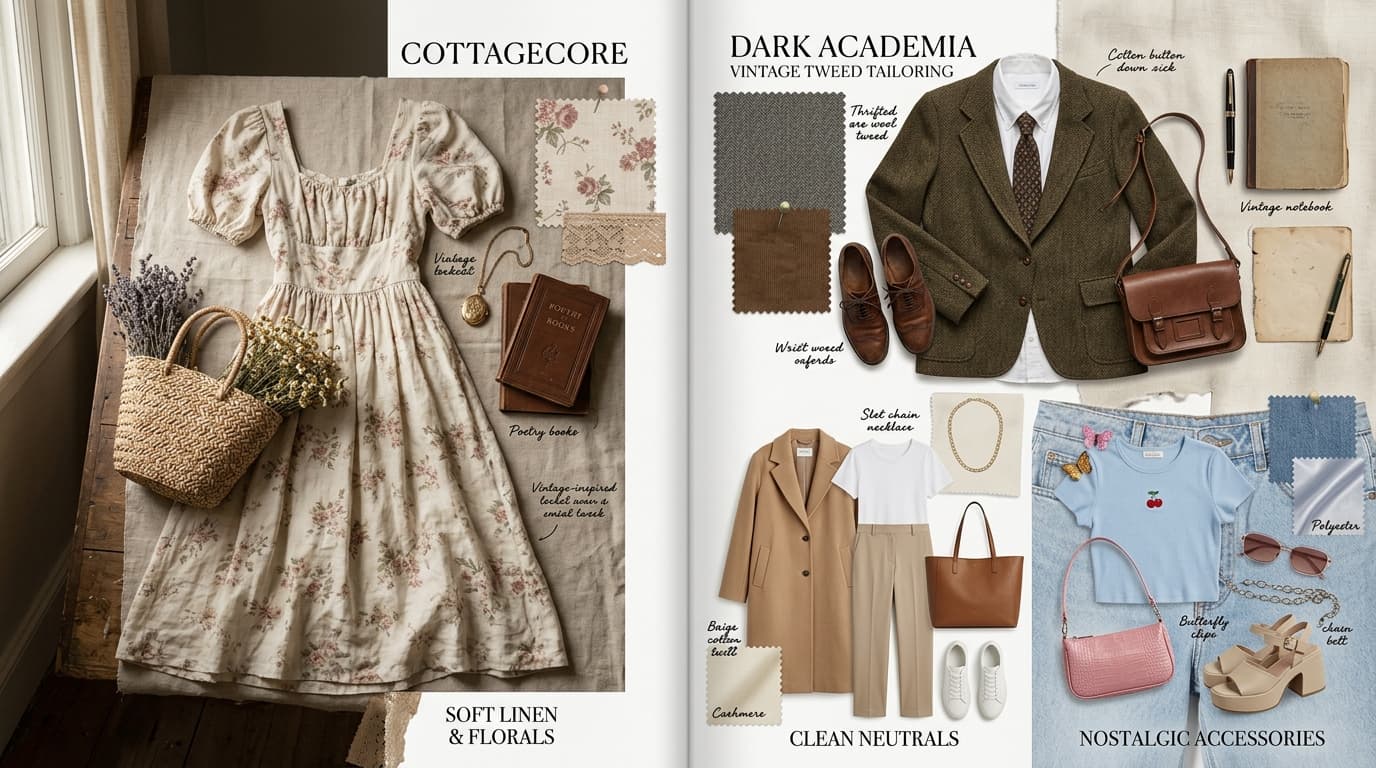
Somewhere in the last few years, “what's your aesthetic” replaced “what's your style” as the more common question, especially online. They sound interchangeable. They are not quite the same thing.
A fashion aesthetic is a specific, named visual world—cottagecore, dark academia, Y2K—each with its own colours, textures, and reference points.
This guide covers what aesthetics actually are, the most popular ones right now, and how to use them without becoming a costume of any single one.
TL;DR
A fashion aesthetic is a specific, named visual theme, like cottagecore or dark academia, built around consistent colours, textures, and references. It is narrower and more explicitly named than personal style. Find yours by noticing which named aesthetics you are drawn to, then build outfits by borrowing elements rather than copying wholesale. Slidez helps you try on aesthetic-inspired pieces and see what actually works on you.
What Are Fashion Aesthetics?
A fashion aesthetic is a specific, named visual theme built around consistent colours, textures, silhouettes, and cultural references, distinct from the broader idea of personal style.
The two terms get used interchangeably, but they describe different things.
Personal Style
The underlying, consistent thread that runs through everything you wear, built from your actual habits and preferences over time. It is personal to you specifically.
A Fashion Aesthetic
A named, shared visual category anyone can opt into. It comes with an existing vocabulary, a reference palette, and often an origin in internet culture rather than in an individual's wardrobe.
As Vogue Business reports on the shift away from algorithmic micro-trends, names like cottagecore and clean girl describe shared visual aesthetics that circulate online; your personal style is how you choose to use—or ignore—those looks.
You can borrow from several aesthetics and still have one consistent personal style underneath. Aesthetics are ingredients. Style is the dish you make with them.
Looking deeper into personal style?
Read our complete beginner's guide to defining your individual look.
Popular Types of Fashion Aesthetics
This list is not exhaustive, and new aesthetics surface constantly, often through social platforms. These are among the most recognised.
Cottagecore
Romantic & RusticSoft, romantic, rural-inspired. Florals, linen, puff sleeves, gingham, earthy tones.
Dark academia
Scholarly & MoodyScholarly and moody. Tweed, plaid, oxford shoes, deep browns and greens, vintage-inspired tailoring.
Light academia
Gentle NeutralsThe brighter counterpart to dark academia. Cream, beige, and soft neutrals, the same scholarly references in a gentler palette.
Y2K
Playful & NostalgicEarly-2000s revival. Low-rise, metallics, butterfly motifs, baby tees, playful and nostalgic.
Coastal grandma
Relaxed & BreezyRelaxed, breezy, neutral-toned. Linen shirts, wide trousers, effortless layering, inspired by seaside ease.
Clean girl
Polished MinimalismMinimal, polished, understated. Slicked hair, neutral tones, simple gold jewellery, an emphasis on looking put together with very little visible effort.
Old money
Quiet LuxuryUnderstated luxury with no logos. Tailored basics, quality fabric, muted colours, a quietly expensive look.
Gorpcore
Outdoor UtilitarianOutdoor and technical wear, worn as everyday fashion. Hiking boots, fleece, technical fabrics, functional silhouettes.
Grunge
Rebellious EdgeRough-edged and rebellious. Flannel, distressed denim, combat boots, dark and muted tones.
Techwear
Futuristic & UtilitarianFuturistic and functional. Technical fabrics, utilitarian details, a monochrome, often black palette.
Coquette
Feminine & PlayfulSoft and feminine with a playful edge. Bows, lace, pastel pinks, ballet-inspired detail.
Balletcore
Dance-InspiredRelated to coquette but more directly dance-inspired. Wrap tops, leg warmers, soft pinks, and ballet flats.
Indie sleaze
Vintage UndoneDeliberately undone, 2000s-indie inspired. Skinny jeans, band tees, smudged eyeliner energy, low-effort layering.
None of these require full commitment. Most people who identify with an aesthetic borrow selectively rather than adopting it head to toe.
How to Find Your Fashion Aesthetic
Finding your fashion aesthetic is a matter of noticing which named categories keep showing up in what you already save, admire, and wear, then narrowing to the ones that hold up over time.
A practical process:
Notice what you save without thinking
Scroll back through outfits you have saved or liked recently. Aesthetic labels often become obvious once you see the pattern laid out.
Name what you are drawn to
If several saved looks would all be tagged “cottagecore” or “old money” by someone else, that is useful information, whether or not you consciously chose that label.
Check what holds up
An aesthetic that still appeals after a few weeks is more likely a genuine pull. One that fades fast was probably a passing mood or a single viral trend.
Expect a blend
Most people land somewhere between two or three aesthetics rather than a pure single one, and that is the normal outcome, not an unresolved answer.
Separate the aesthetic from the outfit
Loving the mood board does not obligate you to recreate it exactly. Take the parts that suit your actual life and skip the rest.
How to Choose Clothes That Match Your Aesthetic
Translating an aesthetic from a mood board into an actual wardrobe works best in small, deliberate steps.
Start with one or two signature pieces
A single item that reads clearly as the aesthetic—a tweed blazer for dark academia, a linen shirt for coastal grandma—does more work than an entire outfit of generic pieces.
Build the palette first
Most aesthetics live or die on colour consistency. Get the palette right and individual pieces become easier to choose correctly.
Prioritise texture and fabric
Aesthetics are often defined as much by material—linen, tweed, technical fabric—as by cut. The wrong fabric can undercut an otherwise correct silhouette.
Adapt to your existing wardrobe
Look for pieces you already own that fit the aesthetic loosely, and build outward from there rather than starting from zero.
Keep proportion and fit in mind
An aesthetic's mood does not override basic fit principles. A piece that reads as the right aesthetic but does not fit well will not look right regardless.
Want to master proportion and fit?
Learn how professional stylists coordinate cuts, proportions, and silhouettes.
How to Mix Different Fashion Aesthetics
Mixing aesthetics works when one holds the base of the outfit and the others contribute individual pieces or accents, rather than each aesthetic competing for equal space.
A few practical approaches:
Pick a dominant aesthetic per outfit
Let one aesthetic set the overall tone, then borrow one or two elements from another to keep it from feeling like a costume.
Use accessories as the bridge
Jewellery, bags, and shoes are the easiest place to introduce a second aesthetic without disrupting the base outfit.
Match the palette even when mixing
Two aesthetics with compatible colour palettes blend far more easily than two with clashing ones, even if their silhouettes differ.
Let occasion guide the ratio
A work setting might call for 80% old money, 20% coquette detail. A weekend look might invert that ratio entirely.
Treat labels loosely
The goal is an outfit that feels coherent to you, not one that satisfies a strict checklist for any single named aesthetic.
Common Fashion Aesthetic Mistakes to Avoid
A handful of recurring mistakes undercut an otherwise good instinct for a given aesthetic.
Full-costume commitment
Wearing every defining element of an aesthetic at once often reads as a costume rather than a considered outfit. Restraint usually looks more intentional.
Chasing every micro-trend aesthetic
New named aesthetics surface constantly online. Committing wardrobe money to each one as it appears risks creating a closet of niche pieces with short shelf lives.
As fashion sustainability analysis in Vogue Business highlights, buying for every fleeting online aesthetic can encourage purchases that do not fit your everyday wardrobe. More broadly, research from the Ellen MacArthur Foundation shows that clothes are being produced in greater numbers and worn fewer times.
Ignoring fit for the sake of the look
A garment that nails the aesthetic's mood but does not fit will still look wrong. Fit is not optional, whatever the aesthetic.
Copying a single mood board exactly
An aesthetic is a direction, not a script. Recreating one specific image outfit for outfit tends to look less natural than adapting the idea to your own body and life.
Forgetting your actual lifestyle
An aesthetic that photographs beautifully but does not survive a commute, a job, or your climate will not get worn.
Assuming an aesthetic is permanent
Aesthetics shift with mood, season, and exposure. Outgrowing one is normal, not a failure of commitment.
Conclusion
Fashion aesthetics are specific, named visual worlds, a useful vocabulary for describing a look, but narrower than personal style itself. The most natural approach borrows selectively from one or several, rather than committing fully to any single label.
Find yours by noticing which named categories keep showing up in what you save and admire, then build outfits around one or two signature pieces rather than recreating an entire mood board.
Virtual Try-On & Personal Styling
Test any aesthetic before you buy
Slidez makes testing an aesthetic low-risk. Import inspiration from Pinterest, TikTok, or Instagram, then try it on virtually to see whether a look genuinely works on you before buying anything. The free version includes all core features.
Download Slidez Free →Frequently Asked Questions
What are the different types of fashion aesthetics?
Popular fashion aesthetics include cottagecore, dark academia, light academia, Y2K, coastal grandma, clean girl, old money, gorpcore, grunge, techwear, coquette, balletcore, and indie sleaze, among many others that surface regularly online. Each is defined by a consistent palette, texture, and set of reference points rather than a strict rulebook, and most people are drawn to more than one.
How do I find my fashion aesthetic?
Look back at what you have recently saved, liked, or admired, and notice which named aesthetics keep recurring. An aesthetic that still appeals after a few weeks is more likely a genuine preference than a passing trend. Most people land somewhere between two or three aesthetics rather than a single pure one, which is the typical outcome rather than an unresolved answer.
What is the difference between fashion style and aesthetic?
Personal style is the consistent, individual thread running through everything you wear, built from your own habits over time. A fashion aesthetic is a specific, named, shared visual category, like cottagecore or dark academia, that anyone can opt into. You can draw from several aesthetics and still have one coherent personal style underneath. Aesthetics are ingredients; style is what you make with them.
Can I have more than one fashion aesthetic?
Yes, and it is the norm rather than the exception. Most people are drawn to two or three aesthetics depending on mood, season, or occasion, rather than committing to a single label exclusively. Mixing works best when one aesthetic sets the base of an outfit and the others contribute individual accents, rather than all competing for equal space at once.
How do I build outfits around my fashion aesthetic?
Start with one or two signature pieces that clearly signal the aesthetic, then build the rest of the outfit around a consistent colour palette. Texture and fabric matter as much as silhouette for most aesthetics. Adapt pieces you already own rather than starting from scratch, and keep basic fit and proportion principles in mind regardless of which aesthetic you are working within.
Can AI help me find my fashion aesthetic?
Yes. AI styling tools let you import outfits and inspiration you are drawn to, then learn from what you save and dismiss to build a picture of your actual preferences over time. Slidez lets you import looks from Pinterest, TikTok, and Instagram and try them on virtually, so you can test whether an aesthetic genuinely works on you before committing to it with a purchase.