
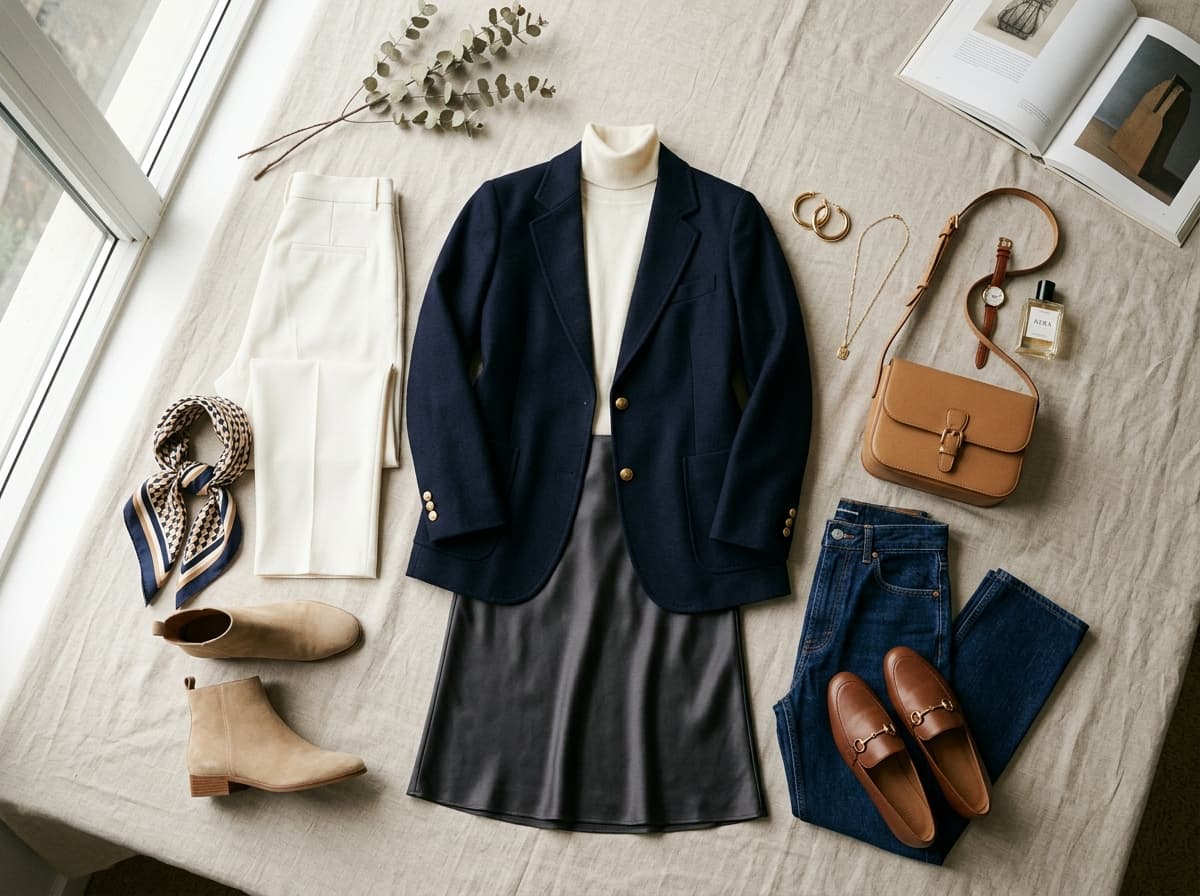
Professional stylists are not working from instinct alone. Behind an outfit that looks effortless is a small set of technical rules, applied consistently: how colors relate, how patterns can coexist, how fabrics pair, and how proportions balance across the body.
None of it is secret. It is just rarely explained plainly. This guide breaks down the actual techniques, the mistakes that undo them, and where AI can now apply the same rules for you.
TL;DR
Matching clothes well comes down to four things: color relationships, pattern scale, fabric weight, and proportional balance. Learn the rules below, or let Slidez apply them automatically and show you the result through virtual try-on.
The Basics of Matching Clothes Like a Professional Stylist
Professional stylists match clothes by controlling four variables at once: color, pattern, fabric, and proportion, so that every piece in an outfit relates to the others instead of competing with them.
The technical skill is not picking good individual pieces. Most people already own plenty of good pieces. The skill is combining them so the outfit reads as a single decision rather than several unrelated ones.
Every principle in this guide reduces to that idea: reducing the number of things competing for attention in an outfit, and making sure what remains relates deliberately.
How to Match Colors, Patterns, and Fabrics
Color
Start from a base and build out. Pick one dominant color, then add no more than two supporting colors. Three total is usually the ceiling for a coordinated look. Celebrity stylist Erica Cloud, in Who What Wear, describes this as a formula of one bright hue, a neutralizing pastel or lighter tone, and a foundational neutral, where the softer middle shade buffers the boldest color so the combination reads as intentional rather than clashing.
Use the color wheel practically. Analogous colors, ones next to each other on the wheel, are the easiest to combine safely. Complementary colors, opposite each other, create intentional contrast when used deliberately.
Neutrals are not the absence of color, they are a tool. Black, white, grey, navy, and beige extend almost any palette and make bold pieces easier to wear.
Match undertones, not just hues. A warm red and a cool red can clash even though both are "red." Consistency in undertone matters more than the color name.
Pattern
One dominant pattern per outfit. A second pattern can work if the scale differs significantly, a fine stripe with a large check, for instance, but two patterns of similar scale usually compete.
Anchor a pattern with a solid. Pairing a patterned piece with solid neutrals lets the pattern be the outfit's focal point instead of one of several.
Consider pattern density. A busy, small-scale print reads differently from a bold, sparse one, even at the same size.
Fabric
Match formality, not just color. A silk top and denim jeans work because the contrast is deliberate. A silk top with athletic fleece usually does not, because the fabrics signal conflicting occasions.
Texture adds interest without adding color. Knit, leather, and suede in a single tonal palette create depth that a single flat fabric cannot.
Weight should feel intentional. Pairing heavy and light fabrics works when it looks like a choice, such as a structured coat over a flowing dress, and reads as a mistake when it looks accidental.
How to Create Balanced Outfit Combinations
Balance is about proportion: how volume, structure, and fit distribute across an outfit.
Fitted with loose. Pairing a fitted top with wider trousers, or a loose top with fitted bottoms, creates intentional shape. Fitted with fitted, or loose with loose, tends to read as less considered. MasterClass notes that voluminous or loose-fitting garments need a fitted or structured counterpart to anchor the look and highlight the body's natural baseline, which is why a wide-leg pant is typically paired with a fitted top rather than another loose piece.
One statement, supporting pieces. A single bold element, a color, a silhouette, a print, reads as confident. Multiple statement pieces compete with each other.
Vertical lines lengthen, horizontal lines widen. Simple, but reliable across body types. Use deliberately rather than by accident.
Define the waist when using volume. Loose pieces on both top and bottom benefit from a visible waistline somewhere, a belt, a tuck, a fitted layer, to prevent the silhouette from reading as shapeless.
Consider proportion relative to your own body. These are starting principles, not rules that override how something actually looks on you. Adjust based on what you see.
For more on how proportion interacts with different body shapes, see our guide on clothing styles for every body type.
Common Outfit Matching Mistakes to Avoid
Most matching failures come from a small, repeatable set of errors.
Too many focal points. Bold color, bold pattern, and bold accessory together compete rather than combine. Choose one.
Mismatched formality. Pairing very casual and very formal pieces works only when it is clearly intentional. By accident, it reads as unfinished.
Ignoring undertone. Two pieces in similar colors but different undertones clash more than two pieces in unrelated colors.
Skipping the finishing layer. Shoes and accessories complete an outfit's logic. Without them, even a well-matched top and bottom can look unresolved.
Matching everything too literally. An outfit built from a single color in identical shades can look flat rather than coordinated. Vary the shade slightly within a color family.
Not testing before committing. Whether by trying pieces on physically or virtually, skipping the check is how most matching mistakes make it out the door.
How AI Fashion Tools Help You Match Clothes Effortlessly
The principles above are learnable, but applying them quickly and consistently across an entire wardrobe is harder than it sounds. AI closes that gap.
It evaluates color, pattern, and proportion simultaneously. Modern systems model outfit compatibility across all of these variables at once, rather than checking one rule at a time. Research on Hybrid-Hierarchical Fashion Graph Attention Networks shows that these systems use multi-head attention mechanisms to weigh relationships between garments, learning which combinations, like a loose wide-leg pant with a fitted top, satisfy human styling heuristics across color, pattern, and silhouette at once.
It learns which combinations you actually like. Every outfit you save or dismiss trains the system on your specific taste, not a generic rule set. Research published in ACM Transactions on Multimedia Computing found that AI systems integrating real-time behavioral reactions build accurate profiles that drastically outperform static, generic rule-based recommendations, even for users whose taste runs counter to conventional styling rules.
It factors in your body. Slidez analyzes your body type from your photo during styling, so proportion-based suggestions account for your actual shape automatically.
It shows you the result. Virtual try-on replaces guessing whether a combination works with seeing it directly, which is the fastest way to confirm the rules above actually apply.
It works on pieces you are considering, too. The Slidez Chrome extension lets you check whether a potential purchase matches your existing wardrobe before you buy it.
For more on the mechanics, see our guide on how to create outfit combinations with AI.
Conclusion
Matching clothes like a professional stylist comes down to controlling a small number of variables well: color relationships, pattern scale, fabric weight, and proportional balance. None of it requires expensive clothing, just deliberate combination.
The mistakes that undo a good outfit are just as consistent as the rules that make one work, which means they are equally learnable to avoid.
Slidez applies these same principles automatically, learns your specific taste over time, and shows every combination on you through virtual try-on before you commit. The free version includes all core features.
Ready to match with confidence? 👉 Download Slidez free.
Frequently Asked Questions (FAQs)
How do professional stylists match clothes?
Professional stylists match clothes by controlling color, pattern, fabric, and proportion together, so every piece in an outfit relates to the others rather than competing. The core skill is combination, not just selecting good individual pieces.
They also work from a small set of consistent rules, such as limiting an outfit to one dominant pattern or one focal point, rather than relying purely on instinct.
How do I match colors when creating an outfit?
Start with one dominant color and add no more than two supporting colors. Neutrals such as black, white, grey, and navy extend almost any palette and make bold pieces easier to wear.
Pay attention to undertone as well as hue. Two shades of the same color can still clash if one leans warm and the other leans cool.
What is the easiest way to create matching outfits?
The easiest reliable method is to build around a tight, coordinated color palette and limit yourself to one dominant pattern per outfit. This removes most of the guesswork before you even consider individual pieces.
Beyond that, using an AI tool that checks colour, pattern, and proportion automatically removes the remaining manual effort.
Can AI help me match clothes?
Yes. AI fashion tools can evaluate color, pattern, and proportion together, learn which combinations you personally prefer from what you save and dismiss, and show the result through virtual try-on.
Slidez also factors in your body type automatically and works on items you are considering buying, not just clothes you already own.
What are the basic rules for matching clothes?
The core rules are: build around one dominant color with no more than two supporting colors, use only one dominant pattern per outfit, match fabric formality to the occasion, and balance fitted pieces with looser ones rather than pairing two of the same silhouette.
These are reliable starting points rather than fixed laws. Adjust based on how a combination actually looks on you.
Which app is best for creating outfit combinations?
Slidez is the strongest option for verifying combinations before committing, since it applies color, pattern, and proportion rules automatically and shows the result through virtual try-on, including for pieces you do not yet own.
For a full comparison, see our guide on how to create outfit combinations with AI.
Ready to see your next combination before you wear it? 👉 Download Slidez free.
References
- Stylist Erica Cloud on How to Wear Spring's Polarizing Color Trends, Who What Wear
- How to Style Paperbag Pants (and Boyfriend Jeans), MasterClass, March 2022
- Hybrid-Hierarchical Fashion Graph Attention Network for Compatibility-Oriented and Personalized Outfit Recommendation, arXiv, August 2025
- Interactive Garment Recommendation with User in the Loop, ACM Transactions on Multimedia Computing, Communications and Applications, December 2024