
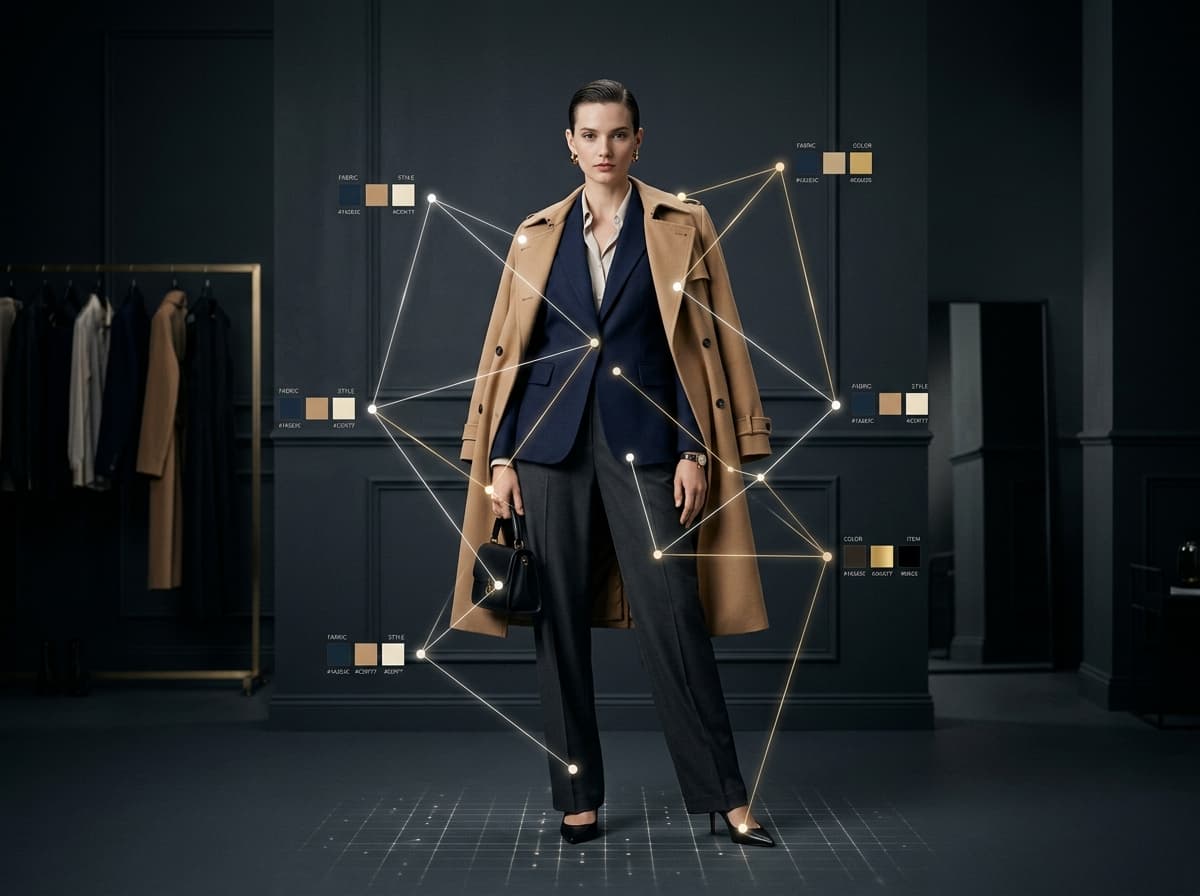
The intersection of artificial intelligence and fashion retail represents one of the most complex domains in applied machine learning. For digital wardrobe and styling platforms such as Slidez, the challenge of automated outfit generation extends far beyond simple product retrieval.
Early algorithmic approaches were largely confined to visual similarity matching—identifying a garment and retrieving physically comparable items based on pixel-level features or metadata tags. However, the modern paradigm of computational fashion styling has transcended these rudimentary systems. Today, advanced recommendation engines model true outfit compatibility by deciphering the nuanced interplay of aesthetic principles, encompassing color harmony, silhouette balance, and stylistic coherence.
This comprehensive analysis details the technological and theoretical underpinnings of next-generation outfit recommendation systems. By synthesizing advanced machine learning architectures—most notably Graph Neural Networks (GNNs), attention mechanisms, and reinforcement learning paradigms—with the structural rules of traditional fashion design, this report provides the empirical foundation validating how algorithmic styling works in practice.
TL;DR
Next-generation fashion recommendation engines use Hybrid-Hierarchical Graph Attention Networks (FGAT) and reinforcement learning to solve the compositionality of outfit styling. Rather than basic pairwise similarity, they compute high-order aesthetic coherence across multimodal visual-textual embeddings, data-driven color compatibility templates, and anthropometric proportion balancing. Modern platforms like Slidez integrate these models with real-time virtual try-on, delivering cohesive, body-aware looks on demand.
1. Graph-Based Architectures for Compatibility-Oriented Recommendation
The fundamental algorithmic challenge in automated outfit generation is that compatibility is an inherently compositional task. A recommendation system must assemble a set of garments that are mutually harmonious across visual style, color palette, formality level, and contextual appropriateness.
This distinguishes outfit creation from single-item recommendation; evaluating the relationship between a blazer, a blouse, tailored trousers, and leather loafers requires modeling complex, high-order interactions rather than computing isolated pairwise distance metrics.
1.1 The Shift from Pairwise to Hierarchical Graph Modeling
Historically, computational compatibility modeling methods were classified into two primary categories: pairwise models and listwise models.
- Pairwise models evaluated the relationship between two specific items using techniques such as metric learning or Siamese networks. While effective for direct item-to-item substitutions, these models failed to capture the holistic coherence of a complete ensemble.
- Listwise models treated an outfit as a sequence (often via Recurrent Neural Networks or LSTMs), which imposed an artificial chronological order on fundamentally unordered sets of clothing, leading to suboptimal feature aggregation.
The paradigm shift arrived with the application of Graph Neural Networks (GNNs) and Graph Attention Networks (GATs) to the fashion domain. In a graph-based framework, fashion entities are mapped as nodes, and their interactions are mapped as edges. Multi-tier heterogeneous graphs simultaneously model universal aesthetic compatibility and user preferences, overcoming the historical challenge of treating aesthetics and personalization as isolated computational tasks.
The Hybrid-Hierarchical Fashion Graph Attention Network (FGAT) constructs a three-level hierarchical graph comprising users, outfits, and individual items:
- User-Outfit Interactions:Edges at the highest level represent a user's historical engagement with complete outfits, capturing implicit taste profiles.
- Outfit-Item Mappings: Edges at the secondary level connect outfits to their constituent garments, representing the compositional structure of a look.
- Item-Item Relationships: Edges at the basal level capture complex compatibility patterns between individual pieces, learned through co-occurrence frequency across vast fashion datasets.
1.2 Multimodal Feature Integration and Graph Attention
To achieve high-precision embeddings, state-of-the-art models do not rely on visual data alone. Deep learning frameworks extract multimodal embeddings, utilizing category-aware encoders like ResNet-152 to generate raw visual features, while simultaneously deploying large language models (such as BERT) to extract deep semantic textual embeddings from item descriptions, materials, and titles. Textual data captures semantic richness—such as fabric weave, brand ethos, or situational appropriateness—that may not be immediately discernible from raw product photography.
Furthermore, these systems employ Graph Attention mechanisms to dynamically weight node importance during representation propagation. Unlike earlier models, such as the Hierarchical Fashion Graph Network (HFGN), which treated all neighboring nodes equally during message passing, an attention-based architecture recognizes that certain items anchor an outfit more strongly than others. For instance, a statement trench coat dictates the style of a look far more than a basic pair of socks.
By calculating attention scores across multiple semantic views (color coordination, brand coherence, silhouette), the network generates refined embeddings. In benchmark testing on the POG (Personalized Outfit Generation) dataset, the FGAT framework significantly outperformed baseline models, proving that combining multimodal visual-textual features with attention-weighted graph propagation yields recommendations that optimize both personalized taste and universal aesthetic harmony.
Curious how outfit generators put these principles to work for daily dressing? Read our comprehensive breakdown of how AI outfit generators work and explore the core AI Outfit Generator hub.
| Model Architecture Paradigm | Primary Operational Mechanism | Data Modalities Processed | Algorithmic Output Focus |
|---|---|---|---|
| Siamese / Pairwise Networks | Pairwise metric distance learning | Visual | Item-to-Item Substitution |
| Bi-directional LSTMs | Sequential item prediction | Visual + Textual | Next-Item Addition |
| Standard GNN (e.g., HFGN) | Equal-weight message passing | Visual | Global Outfit Coherence |
| Graph Attention (FGAT) | Dynamic node weighting (Self-Attention) | Visual + Textual | Unified Compatibility & Personalization |
2. Implicit Feedback and Human-in-the-Loop Personalization
While aesthetic compatibility represents the universal, structural rules of fashion, personalization captures the highly subjective nature of human taste. A mathematically balanced outfit based on color theory and silhouette geometry will still fail to resonate if it contradicts a user's personal identity or situational context.
Therefore, modern AI stylists and digital wardrobe applications rely heavily on implicit behavioral signals to continuously refine their algorithmic recommendations.
2.1 The Limitations of Static Profiling and the Cold Start Problem
Traditional fashion recommendation systems suffered from the notorious "cold start" problem; they relied heavily on rich, pre-existing user profiles, exhaustive onboarding questionnaires, and explicit purchase histories to make accurate suggestions. However, user style is inherently fluid, evolving across seasons, trends, and lifestyle shifts. Relying solely on explicit historical data often locks users into an algorithmic echo chamber, preventing the discovery of new, viable styles.
To resolve this limitation, computer science researchers have pioneered human-in-the-loop systems that build and refine user profiles dynamically, on the fly, without requiring prior explicit questionnaires. These frameworks reframe the recommendation process as a creative co-decision between the user and the styling agent, transforming the digital wardrobe from a static repository into an interactive stylist.
2.2 Reinforcement Learning in Interactive Garment Recommendation
In an interactive garment recommendation framework, the artificial intelligence operates as a reinforcement learning (RL) agent. When a user interacts with a platform like Slidez, their implicit behaviors act as continuous reward or penalty signals for the algorithm:
- Saving a look to a capsule or favorites board (High Positive Reward).
- Swiping to dismiss or replacing a suggested piece (Negative Penalty Signal).
- Zooming in on garment details or checking fabric specifications (Implicit Interest Signal).
- Testing an outfit on their own photo via virtual try-on (Strong Engagement Signal).
Recent research published in the ACM Transactions on Multimedia Computing, Communications, and Applications details how these systems ingest user feedback to maximize long-term user satisfaction. Advanced models utilize architectures such as Self-Supervised Q-learning or Self-Supervised Actor-Critic frameworks to model future rewards explicitly.
For example, if a user consistently dismisses high-contrast color pairings in favor of monochromatic, tonal looks, the neural network dynamically adjusts the weight of its color-harmony view for that specific user's embeddings. If a user saves outfits featuring oversized outerwear but dismisses outfits with fitted jackets, the system's silhouette parameters adapt accordingly. This adaptive learning ensures that the algorithmic stylist evolves alongside the user. Studies evaluating these reinforcement learning agents on large-scale fashion datasets demonstrate a marked increase in hit-ratio metrics and user retention compared to traditional static filtering algorithms.
To understand how this feedback loop impacts retail and return rates, see our analysis on how AI is personalizing online fashion shopping and our guide comparing AI stylists vs human stylists.
See Algorithmic Styling on Your Own Body
Slidez combines graph compatibility engines with instant virtual try-on. Upload a photo or try on garments from any shopping site with our Chrome extension to see personalized looks before making a purchase.
3. Computational Color Theory and Aesthetic Harmony
The perception of an outfit as intentional and "put-together" relies heavily on color coordination. Color harmony is widely recognized as one of the most immediate and significant visual indicators of outfit compatibility. While fashion designers and stylists have traditionally relied on intuitive color theory to build coordinated palettes, translating these subjective principles into mathematical models requires a structured, data-driven approach.
3.1 Classical Color Theory in Fashion Styling
Classical color theory categorizes harmonious pairings through geometric relationships on the traditional color wheel, a concept originating with Sir Isaac Newton in 1704 and refined by Johann Wolfgang von Goethe in 1810. In fashion styling, these principles are deployed to create specific visual effects:
- Analogous Color Schemes: Utilizing hues that sit adjacent to one another on the color wheel (e.g., pairing light blue with teal or navy). This creates low-contrast, visually soothing combinations that feel cohesive, balanced, and effortless.
- Complementary Color Schemes:Utilizing hues positioned directly opposite each other on the color wheel (e.g., burgundy paired with forest green, or fuchsia paired with chartreuse). This results in a high-contrast "power clash" where both colors amplify one another, creating dynamic, editorial statement looks.
- Monochromatic and Neutral Anchoring: The use of varying shades, tints, and textures of a single hue (such as cream, oat, and camel), or relying on grounding neutral colors (black, white, charcoal, slate). Neutral colors serve as a stabilizing canvas for bolder accents, while denim functions as a universal neutral across color families.
Furthermore, color psychology plays a critical role in styling choices. Research indicates that colors elicit physiological and psychological responses; for instance, warm yellows evoke energy and positivity, while forest greens and deep blues exert a calming effect that brings immediate visual harmony.
3.2 Data-Driven Color Compatibility Graphs and Neural Networks
While geometric color models provide a theoretical baseline, they fail to account for the rapid volatility of fashion trends and the subtle nuances of human aesthetic perception. Rigid geometric rules cannot comprehend why a specific shade of "greige" pairs elegantly with a muted mushroom tone in a contemporary minimalist wardrobe, while a mathematically similar high-saturation pairing of neon orange and blue might be rejected by the same user.
To address this, computer vision researchers have developed advanced frameworks that learn color compatibility directly from real-world fashion datasets. Foundational research on learning color compatibility in fashion outfits demonstrates that machine learning models can extract "color compatibility templates" by applying unsupervised clustering algorithms directly to datasets of highly rated, expert-styled ensembles.
In these models, a knowledge graph captures not only the individual colors present in a garment but also the spatial relation and proportional distribution of those colors within the overall look. An iterative prediction and clustering process ensures that the resulting outfit clusters represent meaningful, human-interpretable color templates (such as tonal monochromatic styles versus high-contrast synergy) rather than arbitrary mathematical proximities.
Remarkably, experimental results indicate that machine learning models utilizing color palettes alone—bypassing complex structural deep image features—achieve exceptionally high accuracy in predicting whether an outfit will be perceived as aesthetically pleasing. When combined with deep image features, these color-aware graph networks set new state-of-the-art benchmarks for fashion compatibility prediction, proving conclusively that color coordination acts as the foundational algorithmic layer of visual coherence.
Looking to build a streamlined, cohesive palette for everyday dressing? Explore our guide on building a capsule wardrobe with AI styling tools and our breakdown of digital wardrobes vs traditional closets.
| Color Strategy | Theoretical Basis | Visual Effect | Algorithmic Representation |
|---|---|---|---|
| Analogous | Adjacent hues on the color wheel | Low-contrast, cohesive, soothing | High proximity in embedding vector space |
| Complementary | Opposite hues on the color wheel | High-contrast, dynamic "power clash" | Maximized vector distance with high co-occurrence weighting |
| Monochromatic | Single hue, varying saturation & tone | Polished, elongated, sophisticated | Tight clustering within a single hue subspace |
| Neutral Anchoring | Greyscale, earth tones, denim base | Balanced, versatile, grounding | High baseline compatibility scores across all node types |
4. Silhouette Balance and Anthropometric Proportions
Beyond color theory, the structural geometry of an outfit dictates its ultimate success. The manipulation of silhouette and proportion is a primary concern for fashion designers and stylists, as balancing the visual weight of garments fundamentally affects how intentional, modern, and flattering an ensemble appears to the observer.
4.1 The "Fashion Math" of Proportion Play
In contemporary styling, a coherent outfit rarely relies on identical proportions across the upper and lower body. Instead, stylists advocate heavily for "proportion play," which involves pairing items with contrasting volumes to create visual equilibrium.
For example, a heavily structured, oversized blazer or a voluminous trench coat is optimally balanced by a slim-fitting cigarette pant or tailored straight-leg jeans. Conversely, wide-leg, flowing palazzo trousers are typically anchored by a fitted, cropped, or structured top.
Leading fashion editorials have codified this balancing act into a reliable algorithmic heuristic, often referred to as "fashion math." A widely cited styling principle posits that a successful, modern outfit requires three core structural components:
The 3-Part Outfit Equation ("Fashion Math")
A garment with a standout silhouette, bold color, rich texture, or dramatic volume that dictates the personality and anchors the entire look (e.g., a structured leather wrap coat, an asymmetrical skirt, or an architectural blazer).
A simple, tailored staple (such as classic straight-leg denim, a crisp crewneck tee, or minimalist trousers) that quiets the overall aesthetic, supports the statement piece, and prevents visual chaos.
A deliberate structural adjustment—such as a cinched belt, rolled sleeves, a French half-tuck, or an unexpected contrasting shoe—that refines the silhouette, shifts the mood, and signals intentionality rather than accidental dressing.
4.2 Anthropometric Modeling and Visual Segmentation
From a computational and academic standpoint, proportion in fashion is deeply tied to anthropometrics and human biomechanics. Achieving a proper fit and a visually pleasing silhouette requires a balanced proportion between the human body and the physical clothing.
Academic frameworks utilize tools such as the Body Shape Assessment Scale (BSAS) to evaluate how garments interact with human dimensions, categorizing body silhouettes (e.g., hourglass, pear, apple, rectangle, inverted triangle) based on the ratios between the shoulders, bust, waist, and hips.
Strategic garment construction and styling create optical illusions that interact with these body shapes:
- The vertical placement of high-contrast horizontal lines, the rise of a waistband, or the introduction of a flared hem visually re-segments the torso-to-leg ratio.
- A defined, structured shoulder line offsets wider hips, creating an optical illusion that makes the waistline appear narrower by comparison.
- Monochromatic column dressing eliminates harsh horizontal breaks, visually lengthening the perceived silhouette.
When artificial intelligence systems are trained to recommend outfits, they must explicitly model these structural dynamics. Advanced models evaluate both formality consistency and silhouette matching. If a system ignores proportion, it risks recommending combinations that cluster conflicting volumes (e.g., an oversized, heavy tunic layered over a voluminous, flowing maxi skirt), which violates the principles of visual balance unless requested by avant-garde user styles. By integrating spatial proportion analysis into the graph neural network, AI stylists ensure recommended combinations adhere to the mathematics of engineered aesthetic balance.
Want to calculate your exact body silhouette and find matching styles? Check out our interactive Body Type Calculator and read our comprehensive guide on clothing styles for body types.
5. Validated Source Data for Editorial Integration
To support the editorial dissemination of the computational and stylistic principles detailed in this report, the following data matrix provides source validation evaluated for domain authority, institutional trust, methodological soundness, and temporal relevance.
Interactive Garment Recommendation with User in the Loop
ACM Transactions on Multimedia Computing, Communications, and Applications · January 2025 · Peer-Reviewed Journal
Key Data Point: Modern AI recommendation agents refine user profiles on the fly by utilizing reinforcement learning to process implicit feedback—such as saves, dismissals, and views. This allows the system to dynamically adjust and improve its personalized style suggestions over time without relying on static user questionnaires.
Backup Source: "Domain-aware Multimodal Dialog Systems with Distribution-based User Characteristic Modeling" (ACM Transactions, 2024).
Hybrid-Hierarchical Fashion Graph Attention Network for Compatibility-Oriented and Personalized Outfit Recommendation
arXiv:2508.11105 · August 2025 · Information Retrieval & Machine Learning
Key Data Point: Advanced recommendation algorithms utilize multi-tier Graph Attention Networks (GAT) to map complex relationships between users, complete outfits, and individual garments. By combining visual imagery with textual descriptions, these systems model true aesthetic outfit compatibility (such as color and silhouette) while simultaneously aligning with personal style preferences.
Backup Source: "Hierarchical Fashion Graph Network for Personalized Outfit Recommendation" (Li et al., 2020, IEEE/ACM).
Learning Color Compatibility in Fashion Outfits
arXiv:2007.02388 / Computer Vision and Pattern Recognition (CVPR) · Foundational AI Paper
Key Data Point: Color coordination is the most universal and immediate indicator of whether an outfit reads as put-together. Machine learning models that analyze only the color palettes of clothing can determine aesthetic outfit compatibility with nearly the same accuracy as complex image-recognition models, proving color is the foundational layer of visual coherence.
Backup Source: "How to Match Clothes Using the Color Wheel" featuring stylist Tan France (MasterClass).
Best Outfit Formula 2026: The 3-Part Equation
Who What Wear · Global Fashion Editorial Authority
Key Data Point: Successful outfit styling relies heavily on balancing visual proportions and structure. Coherent looks are achieved by pairing fitted items with loose ones, anchored by a reliable formula: one standout statement piece, a polished grounding neutral, and a deliberate styling adjustment (like a tucked shirt or cinched belt) to create structural equilibrium.
Backup Source: "Body Shape Assessment Scale: Instrument Development for Analyzing Female Figures" (Clothing and Textiles Research Journal).
Ready to Put Fashion AI to Work?
Experience algorithmic styling built with Graph Neural Networks, color theory, and virtual try-on on your mobile device.
Download Slidez FreeAvailable on iOS & Android · Includes Virtual Try-On
Frequently Asked Questions (FAQs)
How do Graph Neural Networks (GNNs) improve outfit recommendations?
Unlike traditional pairwise algorithms that only compare two garments at a time, GNNs model outfits as interconnected networks of nodes (items, categories, users) and edges (compatibility, co-occurrence, preferences). This allows the AI to evaluate complete holistic outfits, factoring in multi-item color balance, material harmony, and silhouette proportions simultaneously.
What is the difference between visual similarity and outfit compatibility in AI?
Visual similarity searches for items that look like an existing piece (e.g., finding another beige trench coat). Outfit compatibility, however, solves a compositional puzzle: selecting different garments (a top, bottom, outerwear, shoes, accessories) that harmonize aesthetically according to color theory, proportion play, and occasion rules.
How does reinforcement learning personalize fashion recommendations?
Reinforcement learning treats every user interaction—saving an outfit, dismissing a combination, zooming in, or performing a virtual try-on—as dynamic feedback. The model adjusts embedding weights in real time, learning not just what individual pieces you like, but how you prefer to combine them across occasions.
Why is color theory so important for algorithmic fashion styling?
Research in computer vision (such as CVPR benchmarks) proves that color palette analysis alone can predict perceived outfit harmony with accuracy rivaling complex full-image models. Color coordination provides the foundational layer of visual coherence, establishing whether an ensemble feels unified or discordant.
How does Slidez apply these algorithmic principles?
Slidez implements graph-based compatibility modeling, user-in-the-loop reinforcement feedback, and body-shape-aware proportion rules. Users can generate complete outfits, import inspiration from social platforms, and see every look rendered on their body using state-of-the-art virtual try-on.
References & Works Cited
- Hybrid-Hierarchical Fashion Graph Attention Network for Compatibility-Oriented and Personalized Outfit Recommendation — arXiv:2508.11105, August 2025
- Learning Color Compatibility in Fashion Outfits — arXiv:2007.02388 / CVPR
- Interactive Garment Recommendation with User in the Loop — ACM Transactions on Multimedia Computing, Communications, and Applications, 2025
- Loom: Hybrid Retrieval-Scoring Outfit Recommendation with Semantic Material Compatibility and Occasion-Aware Embedding Priors — arXiv, 2026
- Hierarchical Fashion Graph Network for Personalized Outfit Recommendation — arXiv:2005.12566, Li et al.
- Exploring AI in Fashion: A Review of Aesthetics, Personalization, Virtual Try-On, and Forecasting — arXiv:2101.08301
- Every It Girl's Outfit Formula for Easy Dressing in 2026 — Who What Wear
- How to Match Clothes Using the Color Wheel — MasterClass Fashion Styling
- Re-evaluating the traditional 8-head figure ratio: examining female body segmentation diversity using 3D body scan data — Taylor & Francis, 2024
- Body Shape Assessment Scale: Instrument Development for Analyzing Female Figures — Clothing and Textiles Research Journal
- A Graph-Based Representation Method for Fashion Color — MDPI Applied Sciences
- Monochromatic Outfits: Stylist Formulas for Elevated Styling — Who What Wear