
Knowing your body shape is not about labels. It is about understanding your proportions so you can dress in a way that feels good, fits well, and saves you from buying clothes that never quite work.
A body type calculator turns that process from guesswork into a quick, clear answer. You enter a few measurements, and the tool tells you which of the common body shapes most closely matches your proportions.
This guide walks you through everything: what a body type calculator is, the measurements you need, how to use the results, and how newer tools (like AI body type calculators and virtual try-on apps) are changing the game.
TL;DR
A body type calculator uses your measurements to tell you which body shape category fits you best. It is useful for understanding proportion, but most people just want clothes that work. Apps like Slidez AI analyze your body type automatically from your photo and use it to personalize outfit recommendations, so you get body-aware styling without filling out a calculator.
What Is a Body Type Calculator?
A body type calculator is an online or in-app tool that takes a few body measurements and tells you which body shape category you most closely match.
Most calculators use three to four measurements (bust, waist, hips, sometimes shoulders) and run them through a formula to identify proportional patterns.
The result is usually one of the common body shapes: hourglass, pear, apple, rectangle, or inverted triangle for women, and rectangle, triangle, inverted triangle, oval, or trapezoid for men.
The point is not to fit you into a box. It is to help you understand how your body is proportioned, so you can dress in ways that feel balanced and confident.
Why Knowing Your Body Shape Matters
Understanding your body shape has practical benefits for everyday dressing and shopping.
You stop fighting your proportions. Some silhouettes work naturally with your shape. Knowing which ones saves time in the fitting room.
You shop smarter. Online clothing returns hover at 20% to 40% industry-wide [CITATION: NRF or Statista return rate data]. Knowing your shape reduces the guesswork on fit.
You build a wardrobe that works together. Pieces in the right silhouettes pair more easily into outfits.
You feel more confident. When clothes fit your proportions, you spend less mental energy worrying about how you look.
You communicate better with stylists or AI tools. Body shape is a shortcut that helps tools (and humans) give better recommendations.
The goal is not to "improve" your body. The goal is to dress for the body you have.
The Most Common Body Shapes Explained
Body shapes are typically grouped into a few common categories. Every body is unique, so think of these as starting points, not rigid boxes.
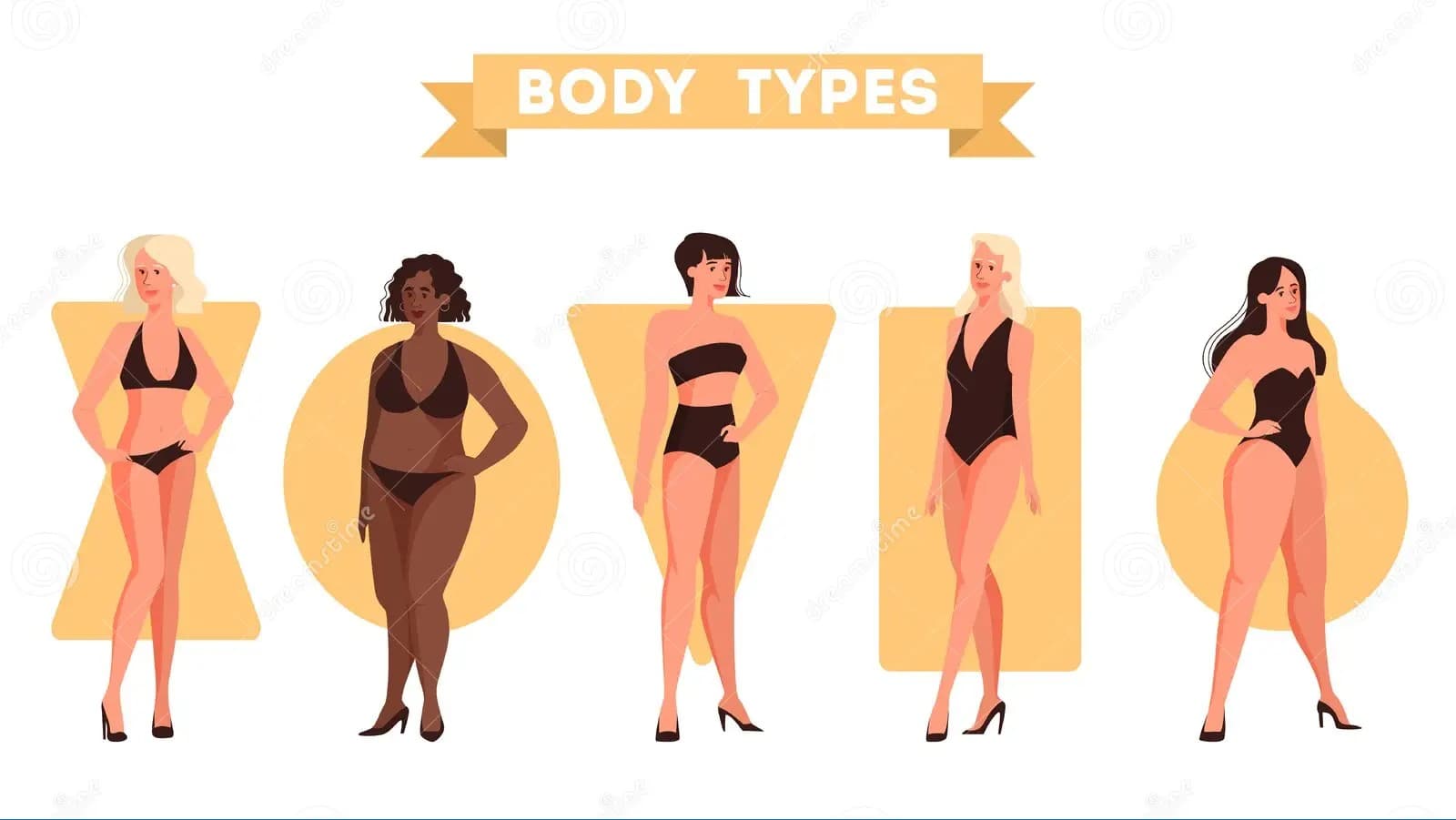
Body Shapes for Women
Hourglass. Bust and hips are roughly equal in measurement, with a clearly defined, narrower waist. Curves are balanced top to bottom.
Pear (also called triangle). Hips are wider than the bust and shoulders. The waist tends to be defined. Weight typically sits in the lower body.
Apple (also called round or oval). The midsection is the fullest part, with the bust and hips narrower in comparison. Legs are often slim relative to the torso.
Rectangle (also called straight or athletic). Bust, waist, and hips are roughly the same measurement. The waist is less defined, and the overall silhouette is column-like.
Inverted triangle. Shoulders and bust are wider than the hips. Often seen in athletic builds.
Body Shapes for Men
Rectangle. Shoulders, chest, and waist have similar measurements. A straight, even silhouette.
Triangle. Waist and hips are wider than the shoulders.
Inverted triangle. Broad shoulders and chest taper into a narrower waist and hips. Typical of athletic and bodybuilder builds.
Oval (or round). Midsection is the fullest part, with shoulders and hips narrower.
Trapezoid. Shoulders are slightly wider than the waist, with a balanced overall silhouette. Often considered the most common male shape.
Most people do not fit one shape perfectly. You might be a rectangle with hourglass tendencies, or an inverted triangle that is close to a trapezoid. That mix is normal.
What Measurements You Need Before Using a Body Type Calculator
You will need three or four specific measurements depending on the tool.
For women:
- Bust: the fullest part of your chest, across the nipples
- Waist: the narrowest part of your torso, usually above the belly button
- Hips: the fullest part of your hips and rear
- Shoulders (optional): straight across the top of your shoulders, edge to edge
For men:
- Shoulders: straight across the top of your shoulders, edge to edge
- Chest: around the fullest part of your chest, under the arms
- Waist: at the natural waistline (above the hip bones)
- Hips (optional): the fullest part of your hips
You need a soft measuring tape and someone to help you take the shoulder measurement accurately (it is hard to do alone).
How to Measure Your Body Correctly
Accurate measurements are the foundation of an accurate body shape result.
A few rules to follow:
- Wear thin, fitted clothing or measure over underwear. Bulky clothes throw off the numbers.
- Stand straight, relaxed, with feet together. No sucking in or pushing out.
- Keep the tape parallel to the floor. Tilted tapes mean wrong numbers.
- Do not pull the tape too tight or leave it too loose. It should sit flat against your skin with no slack.
- Measure each spot twice. If the two numbers differ by more than half an inch, measure a third time.
- Use a soft cloth or vinyl tape measure. Metal tapes do not curve around the body.
- Take measurements at the same time of day. Body measurements can shift slightly throughout the day.
Write each number down before moving to the next measurement.
How a Body Type Calculator Works
The math behind a body type calculator is simpler than it sounds.
The tool compares the ratios between your measurements. For example, if your bust and hips are within 5% of each other and your waist is significantly smaller, the algorithm classifies you as an hourglass.
If your hips are more than 5% wider than your bust, you fall into pear territory. If everything is roughly equal, you are likely a rectangle.
Different calculators use slightly different thresholds, which is why two calculators can give you slightly different results from the same numbers.
The best calculators also factor in your shoulder width, which adds nuance. A tool that ignores shoulders might miss an inverted triangle shape entirely.
Modern AI body type calculators go further, using photos and computer vision instead of (or in addition to) measurements. More on that in a later section.
Step-by-Step Guide to Finding Your Body Shape
Here is the simplest process from start to finish.
- Gather a soft measuring tape, a mirror, and ideally a friend to help with shoulder measurement.
- Wear thin, fitted clothing or just underwear.
- Measure your bust (or chest for men) at the fullest point. Write down the number.
- Measure your waist at the narrowest point of your torso. Write down the number.
- Measure your hips at the fullest point. Write down the number.
- Measure your shoulders if the calculator asks for them.
- Open your chosen body type calculator and enter the numbers.
- Review the result. Most tools also explain why you fall into that category.
- Cross-check with a second calculator if the result feels off.
- Save the result. You will use it for shopping and styling.
The whole process takes about ten minutes once.
Understanding Your Body Type Calculator Results
The calculator gives you a label. The real work is interpreting what it means for how you dress.
A typical result includes:
- Your shape category (hourglass, pear, etc.)
- A short description of the shape's characteristics
- General styling guidance (silhouettes, cuts, fabrics that tend to work)
- Sometimes, recommendations for what to avoid or rethink
Treat this as a starting point, not a rulebook. Your body shape gives you direction. Your personal style, preferences, and comfort decide where you actually go.
Two people with the same body shape will dress completely differently. That is fine. The point is informed choice, not conformity.
How Different Body Shapes Influence Clothing Choices
Some general patterns by shape:
Hourglass. Most clothing styles work, especially anything that follows the natural waistline. Belts, wrap dresses, and tailored cuts tend to feel balanced.
Pear. Tops with structure or detail at the shoulders and necklines that draw the eye upward work well. Straight or A-line bottoms feel comfortable.
Apple. V-necks, structured jackets, and bottoms with a defined waistline often feel good. Empire waist tops and dresses can work nicely.
Rectangle. Layers, belts, and pieces with built-in waist definition create more shape. Peplum tops and fit-and-flare dresses are popular choices.
Inverted triangle. Bottoms with detail (prints, wider cuts, pockets) help balance broader shoulders. Softer top fabrics work well.
Triangle (men). Structured shoulders in jackets and tops add balance. Slim-cut trousers create a streamlined silhouette.
Trapezoid (men). Most cuts work. Slim or modern fits showcase the balanced proportions.
These are starting points, not rules. The only rule that matters is whether you feel good wearing it.
Common Mistakes People Make When Identifying Their Body Shape
A few errors are surprisingly common.
Measuring at the wrong spot. The waist is the narrowest part of your torso, not just where your jeans sit.
Wearing the wrong clothing during measurement. Bulky sweaters add inches.
Pulling the tape too tight. This makes you smaller on paper than in reality.
Skipping the shoulder measurement. This causes inverted triangles to get misclassified as rectangles.
Trusting a single calculator without checking. Calculators can disagree. Use two and look at the consensus.
Treating the result as definitive. Body shapes are guides, not destinies.
Assuming your shape stays constant. Bodies change with age, lifestyle, and hormones. Re-measure every year or two.
The most common mistake is overthinking it. The result is supposed to make your life easier, not harder.
Can AI Body Type Calculators Provide Better Results?
Yes, in many cases. AI body type calculators are an upgrade over traditional measurement-based tools, with some real caveats.
How they work. Instead of (or in addition to) asking for measurements, an AI body type calculator analyzes a photo of you. Computer vision identifies your proportions automatically, without you needing to measure anything yourself.
Advantages:
- More accurate than self-measured numbers (which are often off by an inch or two)
- No measuring tape needed
- Faster, takes seconds
- Some tools also analyze facial features, color palette, and other style factors at the same time
Disadvantages:
- Privacy: your photo is processed by the app. Read the privacy policy.
- Lighting and pose affect accuracy. A bad photo gives a bad result.
- Coverage of diverse body types varies by app. Some tools were trained on narrow datasets and underperform on certain bodies.
- Not every "AI" claim is real. Some apps use AI in name only.
The most accurate approach is often a hybrid: AI photo analysis plus measurement verification.
For a deeper look at how AI uses body data for outfit recommendations, see our guide on how AI outfit generators work.
How Fashion Apps Use Body Shape Data for Personalized Recommendations
Once an app knows your body shape, it can do a lot.
Filtered shopping. Show only items the app predicts will work for your proportions.
Personalized outfit recommendations. Build looks that suit your shape from the inputs available.
Better fit prediction. Use your shape and measurements to estimate sizing across brands (since size charts vary wildly).
Smarter outfit planning. Plan looks that play to your body shape's natural strengths.
Virtual try-on. Show clothes on a model that actually looks like you, not on a stock body.
The most useful apps in 2026 do this analysis automatically. Slidez AI, for example, analyzes your body type from your photo as part of its styling process. Every outfit recommendation factors in your body, and the result is shown through a realistic virtual try-on.
You get personalized, body-aware outfit recommendations without ever filling out a calculator or quiz.
How to Use Your Body Shape to Build Better Outfits
Once you know your body shape, you can use it to plan outfits more strategically.
Build a base of silhouettes that suit you. Find a few core cuts and shapes you know work, and build outfits around them.
Experiment within those silhouettes. Color, pattern, and texture are where you express your personality. The shape is just the canvas.
Use the 80/20 rule. Eighty percent of your wardrobe should be pieces that suit your shape and your life. Twenty percent is for experimenting.
Mix proportions intentionally. Loose top + structured bottom, or fitted top + flowy bottom. These pairings create balance for almost every shape.
Use virtual try-on when shopping new pieces. A try-on shows you the actual look on your actual body, beyond what any calculator can promise.
For specific apps that help you build outfits, see our guide to the best outfit planner apps in 2026.
Does Body Shape Affect Online Shopping Decisions?
Yes, significantly.
Online fashion has a return rate problem. Industry data consistently shows return rates between 20% and 40% [CITATION: NRF or Statista return rate study]. Most of those returns come from fit issues that could have been predicted with better shape awareness.
When you know your body shape:
- You filter out styles that historically do not work for you
- You read reviews more critically (looking for reviewers with similar shapes)
- You check size charts with realistic expectations
- You use virtual try-on tools when available
When you do not know your body shape:
- You buy based on how it looks on the model
- You return items because the silhouette did not work
- You keep buying clothes you do not wear
The cost of not knowing your shape is real. Both in money and in closet clutter.
For a deeper comparison of how try-on changes online shopping, see our guide on virtual try-on vs traditional online shopping.
Body Type Calculator vs Body Type Quiz: What's the Difference?
The two tools sound similar but work very differently.
A body type calculator uses your actual measurements (bust, waist, hips, sometimes shoulders) and runs them through a formula. The result is objective and based on real numbers.
A body type quiz asks subjective questions like "Where do you tend to gain weight first?" or "What part of your body do you feel most confident about?" The result is based on your perception, not your measurements.
The differences in practice:
| Body Type Calculator | Body Type Quiz | |
|---|---|---|
| Input | Real measurements | Subjective answers |
| Time | About 10 minutes (mostly measuring) | 2-3 minutes |
| Accuracy | High, if measurements are correct | Moderate, biased by self-perception |
| Best for | Confirming actual proportions | Getting a quick general sense |
| Bias | Low (math is objective) | High (we see ourselves inaccurately) |
The most accurate result comes from a calculator using real measurements. A quiz is fine as a starting point, but always verify with a calculator.
Conclusion
A body type calculator is a useful tool. It turns a vague question ("what shape am I?") into a clear answer that you can act on.
But the real value is what you do with the result. Knowing your body shape helps you shop smarter, dress with more confidence, and waste less money on clothes that do not fit your proportions.
The newest fashion technology automates this analysis. Slidez AI analyzes your body type from your photo as part of its AI styling, then shows you outfit recommendations with realistic virtual try-on. You get the benefits of body-aware dressing without doing the measuring or labeling yourself.
Knowing your shape is good. Letting AI handle the body analysis while you focus on the clothes is better.
If you want the practical benefits of body-aware dressing without the work of measuring, try Slidez AI.
The free version includes AI outfit recommendations, virtual try-on, and social import from Pinterest, TikTok, and Instagram. Its Chrome extension lets you try clothes from any online store while you browse.
Ready to skip the categorization and see clothes on you? 👉 Download Slidez AI free.
Ready to see clothes on your body?
Download Slidez AI free and skip the categorization entirely.
Download Free AppFrequently Asked Questions (FAQs)
What is a body type calculator?
A body type calculator is a tool that uses your body measurements to tell you which common body shape category fits you best (hourglass, pear, apple, rectangle, or inverted triangle for women; rectangle, triangle, inverted triangle, oval, or trapezoid for men).
It is a starting point for understanding your proportions and how to dress for them.
How accurate are body type calculators?
Body type calculators are very accurate when you measure correctly. Errors usually come from wrong measurements, not from the calculator itself.
For more accuracy, use a calculator that asks for shoulder measurements in addition to bust, waist, and hips. AI-based calculators that analyze photos can also be more accurate than self-measured tools.
What measurements do I need to find my body shape?
The core measurements are bust (or chest for men), waist, and hips. Many calculators also ask for shoulder width, which significantly improves accuracy.
Use a soft measuring tape, wear thin clothing, and measure each spot twice to make sure your numbers are consistent.
Can a body type calculator help me choose better clothes?
Yes. Once you know your shape, you can identify silhouettes that work naturally for your proportions and shop with more confidence.
Apps that combine body shape data with virtual try-on (like Slidez AI) go further by showing how clothes actually look on your body, not just predicting fit from your shape category.
What are the most common body shapes?
For women, the five common shapes are hourglass, pear (triangle), apple (round), rectangle (straight), and inverted triangle.
For men, the five common shapes are rectangle, triangle, inverted triangle, oval (round), and trapezoid.
Most people are a blend of two shapes rather than a perfect match for one.
Is a body type calculator better than a body type quiz?
Yes, in most cases. A body type calculator uses real measurements and produces an objective result. A body type quiz relies on subjective answers and is more vulnerable to self-perception bias.
For the most accurate result, use a calculator. A quiz is fine as a quick starting point.
Can AI determine my body shape from a photo?
Yes, some AI body type calculators analyze a photo to identify your proportions automatically. This is often more accurate than self-measured numbers, because measuring yourself is hard to do precisely.
Slidez AI does this automatically as part of its styling process. From your uploaded photo, the AI analyzes your body type and uses it to personalize every outfit recommendation, no measuring required.
The trade-off across any photo-based tool is privacy. Always read the app's privacy policy before uploading a photo.
Why is knowing your body shape important for fashion?
Knowing your body shape helps you dress for your actual proportions, which makes shopping faster, returns less likely, and outfits more confident.
It is not about idealizing one body type or fitting into a label. It is about practical information that helps you build a wardrobe you actually wear.
Want to skip categorization and see clothes on your actual body? 👉 Download Slidez AI free.