Wide-leg pants have one real styling problem, and everything else follows from it: proportion. Get the proportions right and almost any top works. Get them wrong and nothing does, no matter how good the individual pieces are.
The proportions come down to two measurements. Where the waistband sits, and where the hem ends relative to your shoe. Those two decisions do more than fabric, color, or what you put on top.
This guide covers how to choose the right top, outfit ideas for casual, work, and evening, the shoe question in detail, and how to make the silhouette work on any height.
TL;DR
Wide-leg pants are a proportion problem. Keep the waist high, hem them to your specific shoe height, and keep the top fitted or tucked. Slidez lets you try wide-leg outfits on virtually, which is useful since this silhouette depends entirely on how it falls on your frame.
Why Wide-Leg Pants Are a Versatile Wardrobe Essential
Wide-leg pants cover more occasions than almost any other bottom, because the same cut reads casual in denim and formal in wool.
The silhouette itself carries no formality. What decides it is fabric and what you pair it with, which means one shape serves your whole wardrobe rather than a single setting.
What makes them worth owning:
- They span formality: denim for weekends, wool or crepe for the office, satin for evening
- They are comfortable: no restriction through the thigh, which matters over a long day
- They create a long line: a high waist and a full-length hem produce an uninterrupted vertical from waist to floor
- They suit most body types: with adjustments, which the proportion sections below cover
- They have stayed in rotation: this is not a one-season shape
The thing that determines whether a pair works: drape.
This is the most underrated variable. Wide-leg pants only look good if the fabric hangs down in a clean line rather than standing away from the body.
Drape describes how fabric hangs and forms folds under its own weight. One laboratory measure, the drape coefficient, compares the projected area of a draped circular sample with its original flat area; lower values indicate greater drapability. Fabrics of similar weight can have substantially different drape, so weight alone cannot tell you how trousers will hang. [CITATION-1]
For a fluid silhouette, look for trousers that fall softly in folds. For a more structured shape, choose fabric that holds its form. Check the actual garment rather than relying on the fabric name alone. If a pair of wide-leg pants looks bulky on you, the fabric is usually the reason rather than the fit.
For more on how fabric behavior drives how clothes look, see our guide on how to choose clothes by fit, fabric, and silhouette.
How to Choose the Right Top for Wide-Leg Pants
The top has one job: keep volume on the bottom half only, and make the waist visible.
Wide-leg pants put a lot of fabric below the waist. If the top adds more volume above it, the outfit loses any defined shape. One half carries the volume; the other defines the line.
Tops that work reliably:
- Fitted knits and bodysuits: the simplest answer, since they define the torso completely
- Tucked shirts: a full tuck or front tuck makes the waistband visible, which is the whole point
- Cropped tops: end at or above the waistband, which emphasizes where the leg line starts
- Fitted turtlenecks: clean, and especially good with wool or crepe wide-legs
- A tailored blazer over a fitted layer: structure on top balances fullness below
Tops that need more care:
- Oversized shirts and sweaters: work only if tucked, half tucked, or belted. Untucked over wide-leg pants is the single most common way this outfit fails.
- Long cardigans and duster coats: can work, but they need a fitted layer underneath and ideally a belt
- Boxy tees: fine if cropped or tucked, shapeless if neither
The three reliable configurations:
- Fitted top, high-waisted pants, hem to the floor. The cleanest version.
- Loose top, tucked or belted, defining the waist. Volume both halves, but broken at the waist.
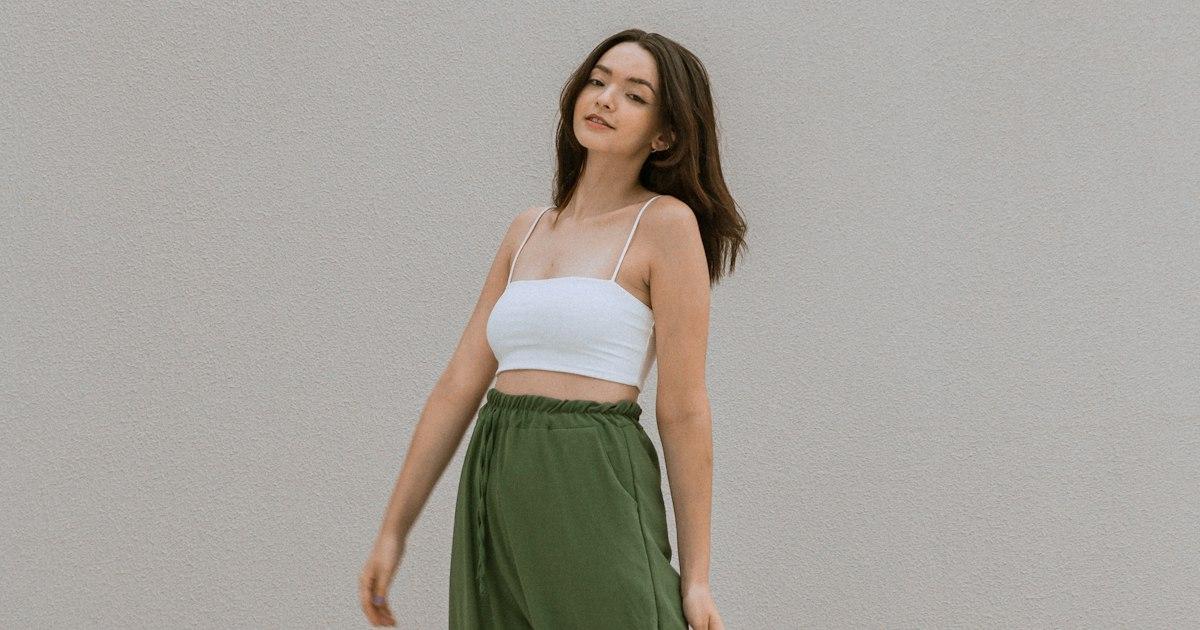
- Cropped top with a high waistband. Maximum leg line, best for casual and warm weather.
The rule underneath all of these: the waistband should be visible or clearly implied. The moment it disappears under an untucked top, the outfit reads as one shapeless column.
Casual Wide-Leg Pants Outfit Ideas for Everyday Wear
Casual wide-leg outfits work best in denim or cotton, with a simple fitted top and a shoe with some height to it.
- Wide-leg jeans, fitted tee tucked, white sneakers. The baseline. A front tuck is doing the work.
- Wide-leg jeans, cropped knit, chunky sneakers or loafers. Crop and high waist together maximize the leg line.
- Linen wide-legs, fitted tank, sandals or flat mules. The warm weather version.
- Wide-leg trousers, tucked striped tee, denim jacket. The jacket adds structure without volume below the waist.
- Wide-leg jeans, bodysuit, oversized blazer. Blazer gives structure; the bodysuit keeps the torso clean.
- Wide-leg joggers or soft trousers, fitted long sleeve, trainers. Comfortable without looking like loungewear, because the top is fitted.
- Wide-leg jeans, oversized shirt belted at the waist, boots. Volume on both halves, broken by the belt.
The casual-specific adjustment: sneakers with wide-leg pants need the hem to clear the shoe, or the fabric pools over the top and shortens the whole line. This usually means a shorter hem than you would use with heels, which is why one pair rarely works with both.
How to Style Wide-Leg Pants for Work and Office
In an office, wide-leg trousers read as tailored rather than casual as long as the fabric is right and the top is tucked.
Fabric is the whole difference here. Wool, crepe, and tailored twill read professional. Denim and jersey do not, regardless of how they are styled.
Reliable office combinations:
- Wool wide-legs, tucked silk or fine-knit top, blazer, loafers or heeled boots. The default.
- Crepe wide-legs, fitted turtleneck, long coat. No blazer needed, still polished.
- Tailored wide-legs with a matching jacket. A wide-leg suit is one of the most comfortable formal options available.
- Wide-legs, tucked white shirt, belt, heeled loafers. Simple and sharp.
- Wide-legs, knit vest over a shirt, flats. Structure at the torso, comfort everywhere.
Office-specific notes:
Hem length matters more in an office because you will be walking on hard floors all day. Too long and the hem frays and gets dirty; too short and the outfit looks unfinished.
Choose a fabric that holds a press. Wool and quality crepe recover from sitting. Linen and softer viscose crease within an hour of sitting at a desk.
A visible waistband reads as deliberate. Tucking with a belt is the easiest way to look assembled in trousers this full.
For broader office dressing, see our guide on autumn work outfits.
Wide-Leg Pants Outfit Ideas for Dates, Parties, and Special Occasions
For evening, fabric does the elevating, and a heel under a floor-length hem produces the most dramatic version of this silhouette.
- Satin or silk wide-legs, fitted bodysuit, heels. The classic evening version.
- Black crepe wide-legs, sequined or embellished top, heeled sandals. Party-ready without a dress.
- Monochrome wide-leg suit in a bold color. One of the strongest statement outfits available.
- Velvet wide-legs, simple fitted knit, heeled boots. Cold-weather evening.
- Wide-legs with a cropped tailored jacket and heels. Sharp, and the crop keeps the waistline visible.
Formal occasions: a wide-leg jumpsuit or a well-tailored wide-leg suit is appropriate at most cocktail and semi-formal events, and increasingly at black tie optional. The fabric needs to be genuinely formal (crepe, satin, velvet, fine wool) rather than an everyday trouser in a dark color.
The evening rule: this is the silhouette where a heel pays off most, because the extra height lets the hem run to the floor and the leg line becomes uninterrupted.
Best Shoes and Accessories to Pair With Wide-Leg Pants
Wide-leg pants are effectively shoe-specific, because the hem has to be cut for the height of the shoe you wear with them.
This is the part most people get wrong, and it is worth more attention than any other styling decision in this post.
The hem rule: the hem should end roughly half an inch to an inch above the ground when you are wearing the intended shoe. Long enough to cover most of the shoe and keep the line unbroken, short enough not to drag.
Because that distance changes with heel height, one pair of wide-leg pants cannot work with both flats and heels unless you are willing to have them altered or accept a compromise. Many people buy one pair and hem it for heels, then wonder why it looks wrong with sneakers.
Shoes that work:
- Heels and heeled boots: the best pairing, since the height lets the hem run long
- Platform shoes and chunky loafers: height without a heel, which is the easiest solution for most people
- Chunky sneakers: work with a shorter, casual hem. Thin flat sneakers often get swamped.
- Pointed flats and mules: the point extends the line, which helps when you are not wearing height
- Ankle boots: work if the hem clears them, awkward if the hem catches on the shaft
What to avoid: anything flat and thin-soled with a hem cut for heels. The fabric pools, the shoe disappears, and the whole leg line shortens.
Accessories:
- A belt: the most useful accessory here, since it marks the waist that the trousers themselves hide
- A structured bag: balances the softness of a full trouser leg
- Longer necklaces: extend the vertical line through the torso
- Keep bags proportionate: a very large slouchy bag next to very full trousers is a lot of volume in one place
How to Make Wide-Leg Pants Flattering on Any Height
The common advice is that wide-leg pants do not suit petite frames. That is not true, but they do need to be cut correctly, which off-the-rack pairs usually are not.
Do wide-leg pants work on petite women? Yes. The problem is almost never the silhouette; it is that standard inseams are cut for average height, so an unaltered pair swamps a shorter frame. Hemming solves most of it.
The adjustments that matter most on a shorter frame:
- Hem them properly. This is non-negotiable and it is the single biggest factor. Petite-specific sizing or a tailor costs little relative to the difference it makes.
- Keep the waist high. A high waistband starts the leg line higher, which is where the apparent length comes from.
- Add height where you can. A platform, block heel, or chunky loafer lets the hem run long without dragging.
- Crop or tuck the top. Keeping the waistband visible is more important on a shorter frame than a taller one.
- Consider monochrome. A single color from waist to shoe removes the horizontal break that shortens the line.
On taller frames: wide-leg pants generally need less adjustment, though very fluid fabrics can look overwhelming if the top is also loose. A fitted top matters as much here.
A note on the “vertical lines are slimming” rule. People often assume wide-leg trousers create a lengthening or slimming effect simply because of the common belief that vertical lines are slimming. Research on striped clothing has produced mixed results: some experiments found that horizontal stripes appeared narrower than vertical stripes, contrary to common fashion advice. Those findings concern stripe patterns, however, and do not establish whether the silhouette of wide-leg trousers makes someone look slimmer. [CITATION-2]
Rather than relying on that shortcut, the advice above is grounded in something more concrete: where the eye reads the waist, and whether the line from waist to floor is broken. Those are the variables you can actually control.
For styling by body shape generally, see our guide on how clothing styles work for every body type.
How to Create Different Wide-Leg Pants Outfits With Slidez
This is a silhouette where seeing it on yourself matters more than usual, because the whole thing depends on proportion relative to your height.
A product photo shows wide-leg pants on a model whose inseam, waist position, and shoe height are all different from yours. Almost none of that transfers.
Slidez lets you try wide-leg outfits on virtually, on your own body. Its AI stylist analyzes your body type from your photo automatically, so the proportions it suggests account for your actual frame rather than a model's.
Where this helps specifically:
- Judging the hem and shoe combination: the decision that makes or breaks this silhouette
- Testing top volume: whether a particular top needs tucking on your frame
- Comparing fabrics: how a fluid pair versus a structured pair reads on you
- Shopping across stores: the Chrome extension works on any online store
Looks save and sync between phone and desktop, so you can build a set of wide-leg outfits once and reuse them.
Conclusion
Wide-leg pants come down to two measurements and one fabric decision. Keep the waist high, hem them for the shoe you will actually wear, and choose a fabric that falls rather than one that stands away from you.
Then keep the volume to one half of the outfit. A fitted or tucked top, with a visible waistband, is what turns a lot of fabric into a deliberate silhouette.
Slidez takes the guesswork out of a shape that depends entirely on proportion. Try wide-leg outfits on virtually, check the hem and shoe pairing on your own frame, and confirm before buying. The free version includes all core features.
Ready to get the proportions right? 👉 Download Slidez free.
Frequently Asked Questions (FAQs)
What tops look best with wide-leg pants?
Fitted tops work most reliably: knits, bodysuits, tucked shirts, cropped tops, and fitted turtlenecks. The principle is to keep volume on the bottom half only and make the waistband visible.
Oversized tops can work, but they need tucking, half tucking, or a belt. Slidez can show you how a particular top reads with wide-leg pants on your own body.
How do you style wide-leg pants casually?
Denim or cotton wide-legs with a fitted tee tucked in and sneakers is the baseline. A cropped knit with a high waistband is the other reliable option.
The casual-specific detail is hem length: sneakers need the hem to clear the shoe, or the fabric pools over the top and shortens the whole line. That is usually a shorter hem than you would use with heels.
What shoes should you wear with wide-leg pants?
Anything with some height works best: heels, heeled boots, platforms, or chunky loafers. The height lets the hem run long, which keeps the leg line unbroken.
Because the correct hem depends on heel height, one pair of wide-leg pants rarely works with both flats and heels. Pointed flats or mules are the best flat option, since the point extends the line.
Can you wear wide-leg pants to the office?
Yes, and they read as tailored rather than casual as long as the fabric is right. Wool, crepe, and tailored twill work; denim and jersey do not.
Tuck your top and consider a belt, since a visible waistband is what makes a full trouser look deliberate. Choose a fabric that holds a press, because linen and softer viscose crease within an hour at a desk.
How do you style wide-leg pants for a formal occasion?
Let the fabric do the elevating. Satin, silk, velvet, crepe, or fine wool with a fitted top and heels reads formal; the same cut in everyday fabric does not.
A wide-leg jumpsuit or a tailored wide-leg suit is appropriate at most cocktail and semi-formal events. A heel helps most here, since the height lets the hem run to the floor.
Do wide-leg pants look good on petite women?
Yes. The common advice against them is mistaken. The problem is almost never the silhouette, it is that standard inseams are cut for average height, so an unaltered pair swamps a shorter frame.
Hem them properly, keep the waist high, add height with a platform or block heel, and crop or tuck the top. Monochrome from waist to shoe helps by removing the horizontal break. Hemming alone solves most of it.
How do you make wide-leg pants look flattering?
Three things: a high waistband, a hem cut for the shoe you are actually wearing, and a fitted or tucked top so the waist stays visible.
Be cautious with the common “vertical lines are slimming” rule, which research on stripe patterns has complicated and which does not directly translate to trouser cuts. Focus instead on where the eye reads your waist and whether the line from waist to floor is broken, since those are the variables you can control.
How can AI help create wide-leg pants outfit combinations?
Proportion is everything with this silhouette, and a product photo shows the pants on a model whose height, inseam, and shoe are all different from yours.
Slidez lets you try wide-leg outfits on virtually and factors your body type into recommendations automatically, which is particularly useful for judging the hem and shoe combination before buying.
Ready to see wide-leg pants on your own frame? 👉 Download Slidez free.
References
- Bona Shin and Changsang Yun, “Multidimensional analysis for fabric drapability,” Fashion and Textiles, Volume 10, Article 33, September 5, 2023. (Methodological reference on Cusick drape testing: Emilija Toshikj and Nina Mladenovikj, “Smartphone-Based Digital Image Processing for Fabric Drape Assessment,” Textiles, Volume 5, Issue 4, Article 63, December 4, 2025)
- Peter Thompson and Kyriaki Mikellidou, “Applying the Helmholtz illusion to fashion: horizontal stripes won’t make you look fatter,” i-Perception, Volume 2, Issue 1, pages 69–76, April 4, 2011. (Additional verification: Antonis Koutsoumpis, Elias Economou, and Erik van der Burg, “Helmholtz Versus Haute Couture: How Horizontal Stripes and Dark Clothes Make You Look Thinner,” Perception, Volume 50, Issue 9, pages 741–756, August 16, 2021)