
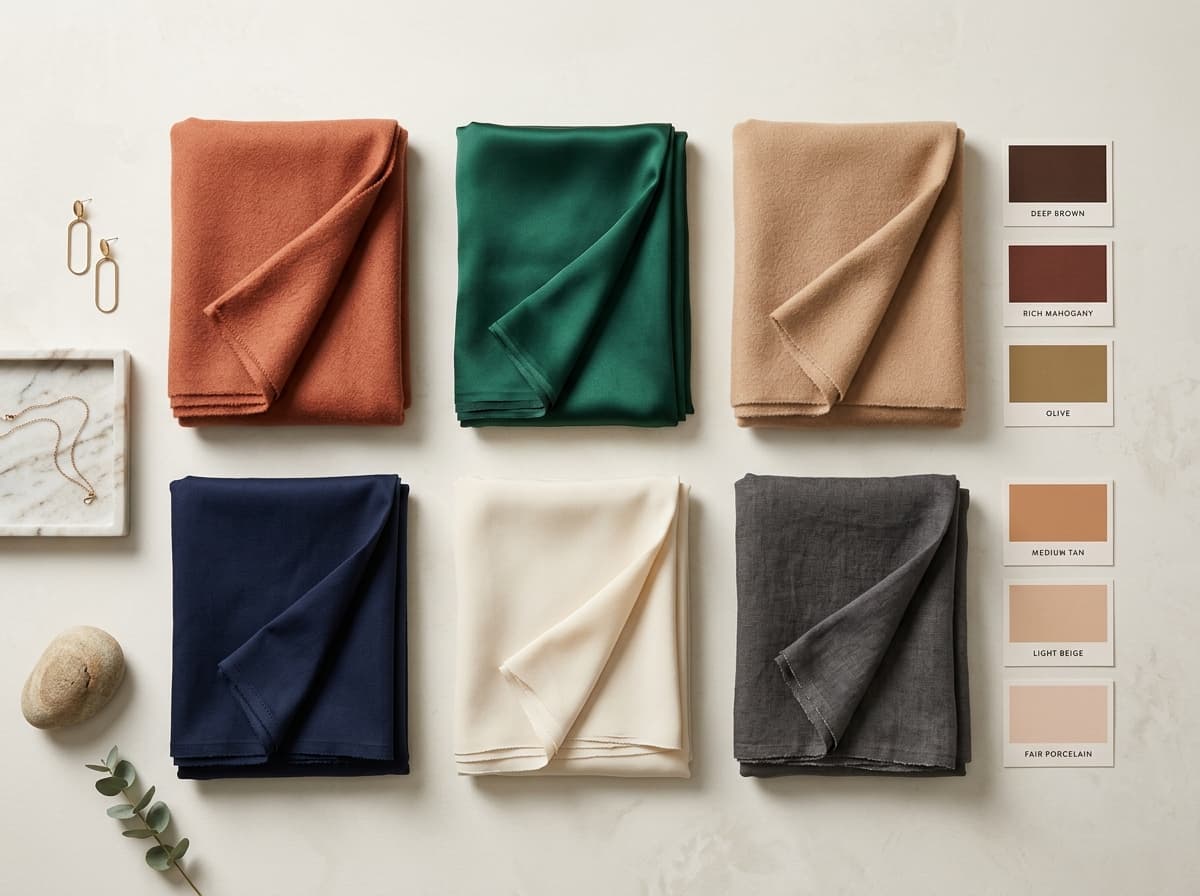
Two people can buy the exact same shirt in the exact same size, and it can look completely different on each of them. Fit is one reason. Color against skin is another, and it gets far less attention.
Every skin tone has colors that make it look brighter and colors that flatten it slightly. Neither is a judgment on the skin. It is simply how color interacts with your specific undertone.
This guide covers how to find your undertone, which colors tend to work with it, and the mistakes that trip people up along the way.
TL;DR
Clothing colors interact with your skin's undertone (warm, cool, or neutral) to look more or less vibrant. Once you know your undertone, choosing flattering colors becomes far easier. Slidez lets you see how any color actually looks against your skin through virtual try-on, so you can judge it directly instead of guessing.
Why Your Skin Tone Matters When Choosing Clothes
Color does not exist in isolation. A shade that looks vivid on a mannequin can look muddy against skin with a clashing undertone, and vice versa.
Undertone changes perceived vibrancy. The same red can look energising on one person and slightly dull on another, depending on how it interacts with their undertone. This comes down to biology: research on the science of seasonal color analysis traces undertone to a specific mix of melanin, hemoglobin, and carotenoids beneath the skin, entirely separate from surface skin depth.
It affects how "fresh" you look. Colors that harmonise with your undertone tend to make skin look more even and awake. Colors that clash can make skin look tired by comparison, purely through contrast.
It is not about a hierarchy of skin tones. Every undertone, across every depth of skin, has colors that genuinely suit it. This is about interaction, not ranking.
It saves money. Knowing your best colors narrows a huge range of choices down to ones far more likely to work, before you buy.
Understanding this is a tool, not a rule. If you love a color that is not technically your "best," wear it. Confidence changes how a color reads more than any theory does.
How to Identify Your Skin Tone
Skin tone and undertone are different things, and the distinction matters here.
Skin tone is the surface color: fair, light, medium, tan, deep, and everything between. It can shift with sun exposure and season.
Undertone is the underlying hue beneath the surface: warm, cool, or neutral. It stays constant regardless of tan or season, and it is the more useful thing to know for choosing clothing colors.
That biological basis — melanin, hemoglobin, and carotenoids acting independently of surface depth — is worth knowing before you try the most commonly cited method for finding your undertone.
Why the vein test is not reliable for everyone. Looking at wrist veins to check for a greenish (warm) or blueish (cool) tint only works optically on light to medium skin. On deeper skin, dense melanin blocks the view of the vessels beneath, so the test simply does not function the way it is often described. If you have tried it and gotten no clear answer, that is the test failing, not you.
The fabric draping test works for every skin depth. Hold a pure white garment and a cream or ivory garment near your face in natural daylight. White reinforcing a pink or blue quality in your skin suggests cool. Cream harmonising with a golden or yellow quality suggests warm. This method relies on light reflecting off fabric onto skin, which works consistently regardless of how much melanin is present, making it the more universally reliable option.
The jewelry test. Gold jewelry tends to flatter warm undertones more; silver tends to flatter cool undertones more. If both look equally good, that points to neutral. Useful as a supporting check, not a primary one.
Sun response. Skin that tans easily and rarely burns often leans warm. Skin that burns before tanning often leans cool. This is a rough guide, and it is the least reliable of the methods here.
Cross-checking two methods, prioritising the fabric draping test, gives a more reliable answer than any single test alone.
For a more automated approach, an AI stylist can help confirm what you see through virtual try-on, covered later in this guide.
Best Clothing Colors for Warm, Cool, and Neutral Skin Tones
These are starting points based on undertone. They are guides, not restrictions, and they apply across every depth of skin tone, from fair to deep.
Warm undertones
Warm undertones tend to be complemented by colors with a golden, earthy, or orange-leaning base:
- Warm neutrals: camel, cream, warm beige, chocolate brown
- Earth tones: olive, mustard, terracotta, rust
- Warm brights: coral, warm red, peach, golden yellow
- Best metals: gold, bronze, copper
Cool undertones
Cool undertones tend to be complemented by colors with a blue, pink, or silver-leaning base:
- Cool neutrals: true white, charcoal grey, navy, black
- Jewel tones: emerald, sapphire blue, amethyst, ruby
- Cool brights: true red, fuchsia, cool pink, icy blue
- Best metals: silver, platinum, white gold
Neutral undertones
Neutral undertones sit between warm and cool, which gives the widest practical range:
- Almost any neutral works: soft white, taupe, grey, navy
- Both warm and cool brights tend to work reasonably well
- Both gold and silver tend to look flattering
- The safest bet: muted, balanced tones rather than extreme warm or cool tones
Whatever your undertone, these lists are a starting point for narrowing choices, not a ceiling on what you are allowed to wear.
Common Color Mistakes to Avoid
A few recurring mistakes account for most color-related disappointment.
Assuming skin tone and undertone are the same thing. A deep skin tone can be warm, cool, or neutral, just as a fair skin tone can. Depth and undertone are independent variables.
Judging color under bad lighting. Fluorescent store lighting distorts color significantly. Always check a garment in natural daylight before deciding it does not work.
Treating "your colors" as a strict rulebook. These are tendencies, not laws. Plenty of people wear "wrong" colors and look great, because fit, styling, and confidence matter too. Who What Wear reports that professional colour analysts themselves describe seasonal palettes as a foundation for confidence, not a restriction, and encourage clients to keep wearing colours they love and feel powerful in.
Ignoring proximity to the face.A color's effect is strongest near your face. The same shade in shoes matters far less than in a top or scarf.
Avoiding color entirely out of uncertainty. Defaulting to black or grey because you are unsure of your undertone means missing colors that might genuinely suit you. Testing beats avoiding.
Not accounting for fabric finish. Matte and shiny fabrics reflect color differently. A shade that looks muted in cotton can look completely different in silk or satin.
How AI Fashion Tools Help You Choose Colors That Suit You
Working out your undertone and testing colors used to require either a professional colour consultant or a lot of trial and error. AI makes both faster.
Virtual try-on shows the real interaction. Rather than guessing how a color will look against your specific skin, you see it directly. This is the most reliable check available, because it removes the guesswork entirely. Grand View Research values the global virtual try-on market at $9.2 billion in 2023, projecting growth to $46.4 billion by 2030, driven largely by its ability to let shoppers see accurate colour and texture on themselves before buying.
Slidez lets you try on any piece and see exactly how the color reads against your skin, in the lighting and styling of the actual outfit, rather than judging from a product photo shot on a different person entirely.
It learns your preferences over time. As you save and dismiss outfits, the system builds a picture of the colors you consistently reach for and the ones you consistently skip. Research published in ACM Transactions on Multimedia Computing found that AI systems using implicit feedback build accurate style profiles by tracking real reactions like saves and dismissals, outperforming models that rely on explicit questionnaires.
It applies your palette automatically. Once your colour preferences are established, recommendations lean toward shades that have worked for you before, without you needing to consciously filter for them.
It removes the lighting problem. Testing a color virtually, in consistent conditions, avoids the distortion that store lighting or a poorly lit photo can introduce.
Colour analysis has seen a genuine resurgence recently, particularly among people rediscovering it through social platforms. ELLE reports that the trend, propelled largely by TikTok, helps people navigate decision fatigue in a fast-moving trend cycle.
AI tools make that same idea practical day to day, rather than a one-time consultation you do once and forget.
Conclusion
Choosing clothes that match your skin tone comes down to one variable: undertone. Warm, cool, or neutral, once you know yours, narrowing down flattering colors gets much easier.
None of this is about restriction. It is about starting from a smarter place, then wearing whatever makes you feel good, informed by what you now know rather than guessing blind.
Slidez makes the testing part effortless. Try on any piece and see exactly how the color reads against your skin, and let the app learn your palette as you go. The free version includes all core features.
Ready to find your colors? 👉 Download Slidez free.
Ready to find your colors?
Download Slidez AI free and see how any color actually looks on your skin.
Download Free AppFrequently Asked Questions (FAQs)
How do I know my skin tone?
Skin tone is your surface color, while undertone is the underlying hue beneath it (warm, cool, or neutral), and undertone is what matters most for choosing clothing colors.
To check your undertone, look at your wrist veins in natural light (greenish suggests warm, blueish suggests cool), or compare how white versus cream looks near your face. Cross-checking two methods gives a more reliable result than relying on one.
What colors look best on warm skin tones?
Warm undertones tend to be complemented by colors with a golden or earthy base: camel, olive, mustard, terracotta, coral, and warm red. Gold and bronze tones in jewelry and accessories also tend to work well.
These are starting points rather than restrictions. The goal is narrowing your options, not limiting them.
What colors suit cool skin tones?
Cool undertones tend to be complemented by colors with a blue or pink base: true white, navy, charcoal, emerald, sapphire, and true red. Silver and platinum tones in jewelry and accessories tend to work well too.
As with warm undertones, treat this as a helpful starting point rather than a fixed rule.
Can AI help me choose clothes that match my skin tone?
Yes. The most reliable way to check whether a color works for you is to see it against your actual skin, and virtual try-on does exactly that.
Slidez shows you how a garment's color reads on you directly, and learns your color preferences over time from what you save and try. This removes the guesswork of judging color from a product photo shot on a different person under different lighting.
Do clothing colors really make a difference?
Yes, though the effect is about harmony rather than a strict right or wrong. Colors that suit your undertone tend to make your skin look more even and vibrant, while colors that clash can create a slightly duller contrast.
That said, fit, styling, and confidence all matter alongside color. A color theoretically outside your palette can still look great if the rest of the outfit and your confidence in it are strong.
What is the best app for finding colors that suit my skin tone?
Slidez is a strong option because it lets you test any color directly through virtual try-on rather than relying on a one-time analysis, and it keeps learning your preferences as you use it.
Dedicated color-analysis apps can also help identify your seasonal palette as a starting point, which you can then test and refine using try-on.
Ready to see how colors actually look on you? 👉 Download Slidez free.
References
- The Science of Seasonal Color Analysis, HueCheck White Paper, February 2026
- I Thought I Knew My Best Color, But a Pro Completely Changed My Mind, Who What Wear, 2024
- Virtual Try-on Market Size, Share & Trends Analysis Report, Grand View Research, July 2024
- Interactive Garment Recommendation with User in the Loop, ACM Transactions on Multimedia Computing, Communications and Applications, December 2024
- Why Everyone Is Getting Their Colors Analyzed Right Now, ELLE Magazine, April 2025