
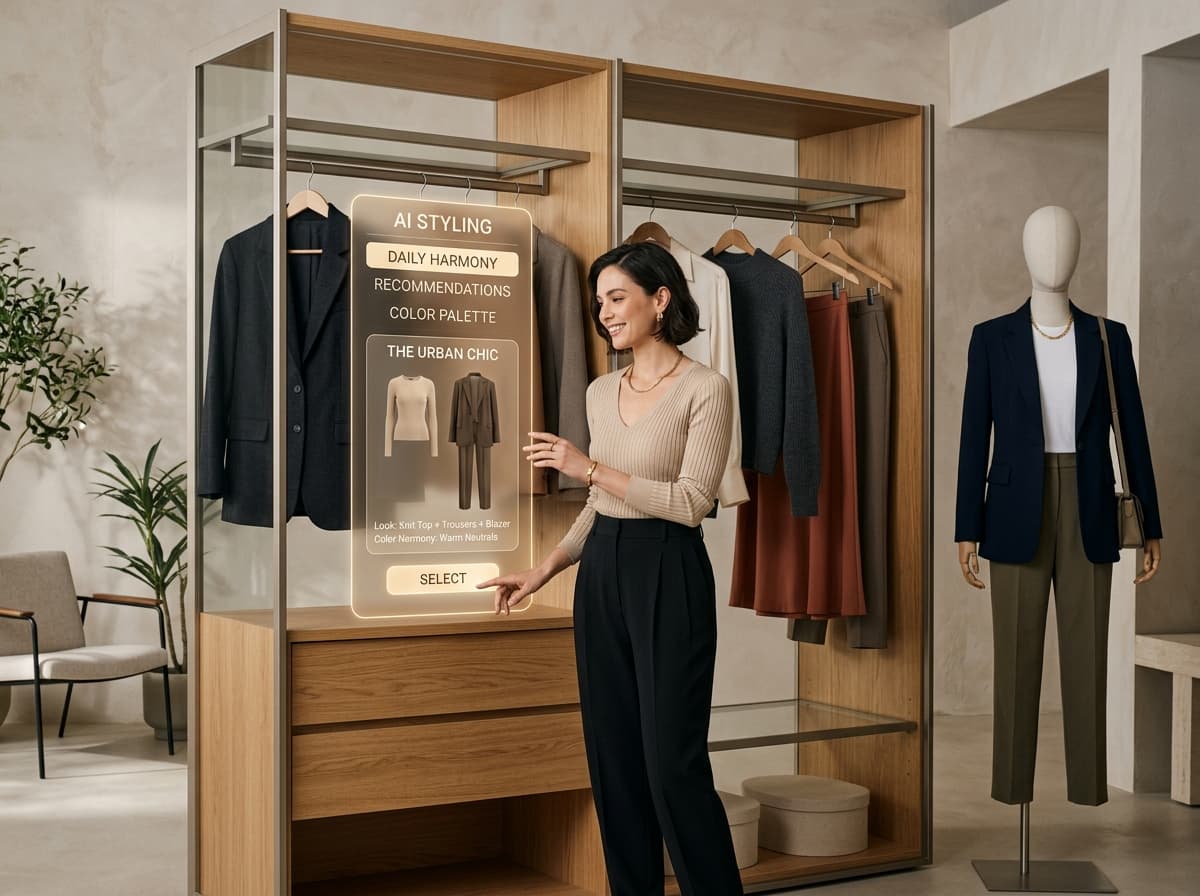
The usual complaint about clothing recommendations is that they are generic. You look at one striped shirt and get shown forty more striped shirts, none of which solve the actual problem of what to wear.
AI outfit recommendations work differently. Instead of retrieving similar items, they assemble complete looks that account for your body, your taste, and the occasion.
This guide covers how that process works, why it produces more accurate results than shopping unaided, and the factors that determine whether a recommendation is genuinely good or merely plausible.
TL;DR
AI outfit recommendations assemble complete looks by modeling how garments work together, then filtering through your body and personal taste. Accuracy improves with use and with better inputs. Slidez adds the step that matters most: showing each recommendation on you through virtual try-on, so you verify rather than trust.
What Are AI Outfit Recommendations?
An AI outfit recommendation is a complete, coordinated look assembled by artificial intelligence, tailored to a specific person and occasion, rather than a list of individually suggested garments.
The distinction matters more than it sounds. A product recommendation answers “what else might you like?” An outfit recommendation answers “what should you wear?”
The second question is harder, because it requires modeling relationships between garments, not just similarity between them. A shirt and a pair of trousers can both suit you individually and still look wrong together.
Systems that get this right evaluate compatibility across colour, proportion, formality, and context simultaneously.
Similarity Matching
Finds products that look like what you just clicked. Ignores styling context, body proportions, and coordination with what you already own.
Compositional Styling
Assembles complete head-to-toe outfits. Evaluates color harmony, silhouette balance, and personal fit verified on your actual photo.
How AI Generates Personalized Outfit Recommendations
AI generates outfit recommendations by modeling garment compatibility, then personalizing the result using your body data, style history, and the occasion you specify.
The pipeline runs in layers:
Compatibility Modeling
The system evaluates how candidate garments relate to each other, learning coordination patterns from large datasets of styled outfits rather than applying fixed rules. Research on Hybrid-Hierarchical Fashion Graph Attention Networks shows that modern AI systems determine outfit compatibility by mapping complex stylistic relationships using hierarchical graphs that integrate both visual and textual garment data simultaneously.
Style Personalization
Your saves, dismissals, and repeat views build a profile of your actual taste, which is usually more accurate than what you would report about yourself. ACM research on interactive garment recommendation found that AI systems using reinforcement learning can construct and dynamically update accurate style profiles in real time from implicit behavioral signals, significantly outperforming models that rely on explicit questionnaires.
Body Awareness
Computer vision can estimate proportions from a photograph, so recommendations account for how a cut will sit on you. Cloth2Body research from IEEE/CVF ICCV demonstrated that modern models can infer a complete 3D body mesh from a single clothed photograph, bypassing the need for manual measurement. Slidez does this automatically during styling, without measurements or a quiz.
Context Filtering
Occasion, weather, and dress code narrow the candidate set before anything is assembled. Specifying daytime casual vs evening formal adjusts fabric weights, color palettes, and layering structures.
Visual Verification
The strongest tools render the finished look on your own image, converting an abstract prediction into something you can judge directly before making purchase or outfit decisions.
Why AI Outfit Recommendations Are More Accurate Than Traditional Shopping
Traditional shopping is not a low-tech version of this process. It is a fundamentally worse-informed one.
“The comparison worth making is not AI against a professional stylist. Most people were never going to hire one. It is AI against shopping alone with imperfect memory, which is a contest AI wins comfortably.”
Factors That Improve the Accuracy of AI Outfit Recommendations
Accuracy is not fixed. It depends heavily on inputs, and there is a lot you control.
Volume of Feedback
Every save and dismissal sharpens the model. Users who rate consistently get noticeably better results within a couple of weeks.
Quality of Your Photo
Body-aware styling depends on a clear, well-lit, full-body image. A poor input produces a weaker estimate.
Specificity of the Request
“Outdoor autumn wedding, afternoon, smart-casual” produces a far better result than “something nice.”
Wardrobe Visibility
Recommendations improve when the system knows what you already own, because coordination can be checked against real items.
Direct Inspiration
Importing outfits you genuinely love, from Pinterest, TikTok, or Instagram, teaches taste faster than passive browsing.
Time & Compounding
Cold-start recommendations are the weakest a system will produce. Personalization compounds with use over time.
Where accuracy is still limited
Being straight about this matters, because overstated claims are easy to disprove.
- Fabric and drape: No current system conveys weight, texture, or how a material moves. This remains a real advantage of physical shopping.
- Very niche or cultural dress: Models trained on mainstream fashion data perform less well outside it.
- Representation gaps: Where training data underrepresents certain body types or skin tones, output quality suffers accordingly.
- Rendering limits: Virtual try-on is strong on proportion, length, and colour, and weaker on complex draping.
The practical conclusion is to treat AI recommendations as strong guidance, verified visually, rather than as certainty.
How AI Is Transforming the Future of Fashion Recommendations
Several shifts are already underway:
Photorealistic try-on
Generative models are steadily closing the gap between a rendered look and a photograph. McKinsey projects that generative AI technologies could add $150 billion to $275 billion to operating profits across the apparel and luxury sectors over the next three to five years, driven in part by virtual try-on reducing return rates and production costs simultaneously.
Brand-level fit prediction
As retailers expose more granular garment measurements, recommendations will become brand-specific rather than generic.
Conversational styling
Describing what you need in plain language, then refining through dialogue, is replacing filter menus as the primary interface.
Cross-retailer recommendations
Tools that work across any store, rather than inside one retailer's catalogue, give recommendations a much larger candidate pool. The Slidez Chrome extension already operates this way.
Sustainability signals
Cost per wear and garment longevity are moving into the recommendation itself rather than sitting in a separate report.
The direction is consistent: fewer suggestions, better matched, verified before purchase.
Conclusion
AI outfit recommendations are more accurate than unaided shopping because they solve a problem people cannot solve reliably on their own: holding an entire wardrobe, a body, a taste profile, and an occasion in mind at once, then assembling something coherent from all four.
They are not infallible. Fabric, niche dress, and complex draping remain genuine weak points, and accuracy depends on the inputs you give.
What closes most of the remaining gap is verification.
Verify Outfits on Yourself Before You Buy
Slidez generates outfit recommendations for any occasion, reads your body type from your photo during styling, and shows every look on you through realistic virtual try-on. Its Chrome extension works across any online store.
The free version includes all core styling features.
Frequently Asked Questions (FAQs)
What are AI outfit recommendations?
AI outfit recommendations are complete, coordinated looks assembled by artificial intelligence for a specific person and occasion, rather than lists of individually suggested garments. The difference is that they model how pieces work together, not just whether you might like each piece on its own.
How does AI recommend outfits?
AI recommends outfits by evaluating how candidate garments coordinate across colour, proportion, and formality, then personalizing the result using your style history, body proportions, and the occasion you specify. The strongest tools finish by rendering the look on your own photo, so you can judge the recommendation visually rather than taking it on trust.
Why are AI outfit recommendations more accurate?
They are more accurate than shopping unaided because they hold information a shopper cannot: your full wardrobe, your proportions, your taste history, and coordination patterns learned from large volumes of styled outfits. They also learn from outcomes. A system that sees which suggestions you dismiss improves over time, which no shop assistant can do.
Does AI consider my body type and personal style?
The better tools do both. Computer vision can estimate your proportions from a photo, and behavioural signals build a picture of your taste that is usually more accurate than self-description. Slidez analyses your body type automatically from your photo during styling. You are never shown a shape label; the analysis simply informs what gets recommended.
Can AI recommend outfits for different occasions?
Yes, and occasion is one of the most useful inputs you can give. Specifying the event, setting, and time of day narrows the candidate set considerably and produces a much more usable result. Vague requests produce vague recommendations. Specific ones produce outfits you can actually wear.
What is the best AI app for outfit recommendations?
It depends what you need. Slidez is strongest when you want recommendations you can verify visually before wearing or buying, including for items you do not yet own, with a Chrome extension that works on any store. Apps such as Alta, Acloset, and Whering are better suited to generating recommendations from a wardrobe you have already catalogued in the app.
References
- Hybrid-Hierarchical Fashion Graph Attention Network for Compatibility-Oriented and Personalized Outfit Recommendation, arXiv / Machine Learning with Applications, August 2025
- Interactive Garment Recommendation with User in the Loop, ACM Transactions on Multimedia Computing, Communications, and Applications, December 2024
- Cloth2Body: Generating 3D Human Body Mesh from 2D Clothing, IEEE/CVF International Conference on Computer Vision (ICCV), October 2023
- The Choice Overload Effect in Online Recommender Systems, Manufacturing & Service Operations Management (INFORMS), October 2024
- The True Cost of Apparel Returns: Alarming Return Rates Require Loss-Minimization Solutions, Coresight Research, 2023
- Generative AI: Unlocking the Future of Fashion, McKinsey & Company, March 2023